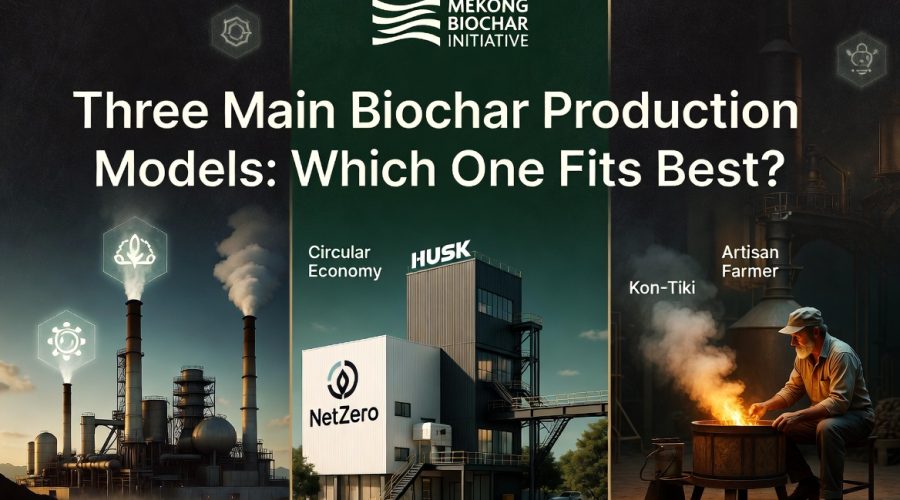
Three Main Biochar Production Models: Which One Fits Best?
The biochar industry features three distinct production models, each with unique advantages, challenges, and suitability for different contexts. The Nitidae Biochar Market Study (June 2025) provides a clear framework for understanding these models, which is essential for investors and project developers, especially in the Global South and Mekong Region.
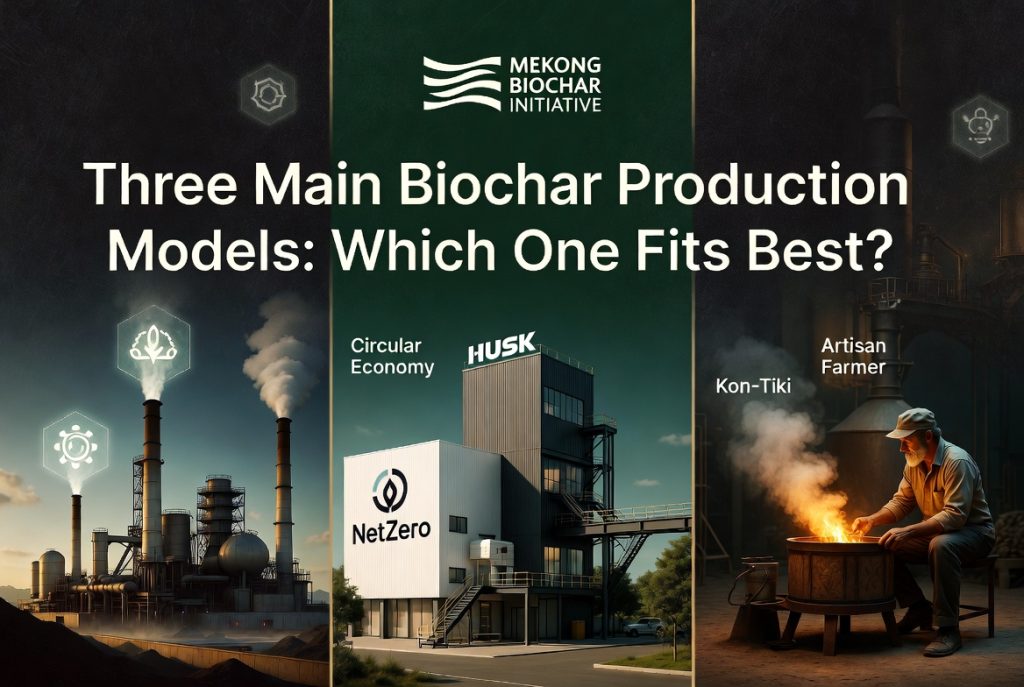
1. Industrial Production: Biochar as a Co-Product of Energy
This is the oldest model, where biochar is produced as a by-product of energy generation through pyrolysis or gasification.
Key Characteristics:
- Main revenue from energy sales or waste treatment fees
- Biochar is often given away or sold at low prices
- Large-scale facilities (e.g., Agri Energy Vraa project in Denmark using Stiesdal technology)
- Common in Europe due to high energy prices and decarbonization targets
Advantages:
- Strong financial stability from energy revenue
- Easier access to subsidies
- High processing capacity
Challenges:
- Dependence on energy markets and industrial partners
- Less focus on biochar quality and marketing
- High capital investment required
2. Industrial Production: Biochar as the Main Product
This model focuses primarily on maximizing biochar output and carbon credits.
Key Characteristics:
- Companies like NetZero (Cameroon, Brazil) and HUSK (Cambodia, Vietnam)
- Strong emphasis on circular economy: biomass from local value chains → biochar returned to the same chains
- Revenue split: 20–80% from carbon credits
- Advanced logistics optimization to minimize emissions in Life Cycle Assessment (LCA)
Advantages:
- High scalability and replicability
- Full control over biochar quality and marketing
- Strong focus on both physical sales and carbon credits
- Flexible across different geographies and feedstocks
Challenges:
- Higher dependence on carbon credit prices
- Need for strong physical market development
- Complex logistics and biomass supply security
3. Artisan (Small-Scale) Production
This model uses low-cost, simple technology such as Kon-Tiki kilns and engages smallholder farmers directly.
Key Characteristics:
- Certified under Artisan C-sink standard by Carbon Standard International (CSI)
- Projects like RecyCoal in Rwanda and Planboo
- Farmers produce biochar on their own land and receive a share of carbon credits
- Production limit: ~40 tons per artisan per year
Advantages:
- Low investment cost
- High social impact and community involvement
- Fast deployment and scalability through networks
- Excellent for rural development
Challenges:
- Lower and more variable credit quality perception
- Difficult quality control and traceability
- Lower individual production volumes
Which Model is Best for the Mekong Region?
For the Mekong Basin, a hybrid approach combining elements of Model 2 (Industrial Main Product) and Model 3 (Artisan) appears most promising. The region has abundant agricultural residues (rice husks, coffee parchment, cashew shells) and many smallholder farmers who could benefit from additional income.
Mekong Biochar Initiative (MBI) recommends starting with circular industrial projects anchored by cooperatives or processors, while simultaneously rolling out artisan programs to engage small farmers. This balanced strategy maximizes carbon credit revenue while building genuine local demand for physical biochar.
Key Success Factors Across All Models:
- Secure, low-cost biomass supply
- Strong Life Cycle Assessment (LCA) performance
- Robust dMRV (digital Monitoring, Reporting & Verification) systems
- Balanced revenue from both physical biochar and carbon credits
- Continuous R&D and farmer training
Conclusion
There is no single “best” model — success depends on local context, available biomass, investment capacity, and target outcomes. The most resilient projects are those that intelligently combine the strengths of multiple models while maintaining focus on both environmental integrity and economic viability.
As the global biochar market expands rapidly toward 2028, the Mekong Region has a unique window of opportunity to develop tailored production models that serve both climate goals and local farming communities.
Contact Mekong Biochar Initiative
Website: https://mekongbiochar.com
Email: office@mekongbiochar.com
Hotline: +84 988 203 940
Linkedin : https://www.linkedin.com/company/mekong-biochar-initiative/