Surface Area and Adsorptive Properties of Biochar from Combined Heat Gasifiers
Biochar produced from combined heat and biochar gasifiers using homogeneous biomass typically exhibits a specific surface area (SSA) ranging from 250–665 m²/g, depending on the feedstock and gasification temperature. This finding is supported by the study “Physical and chemical characterization of biochars derived from different agricultural residues.”
Such a large surface area provides an ideal habitat for beneficial microorganisms—including gut microbes in livestock, insects, earthworms, fermentative microbes, and composting strains.
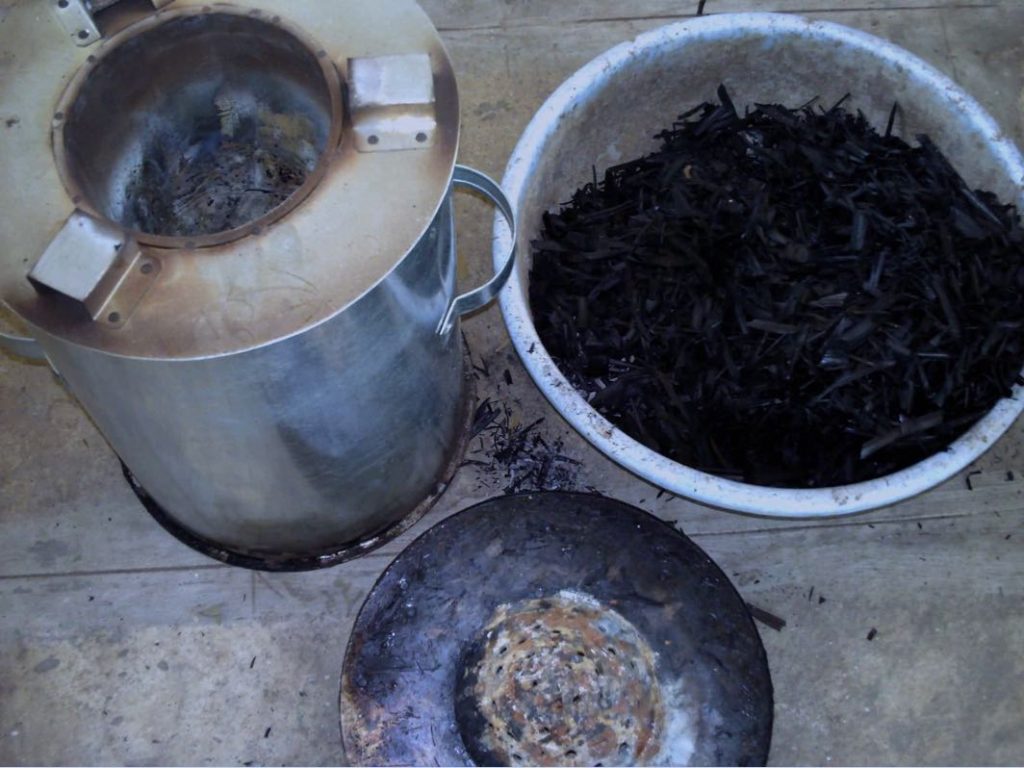
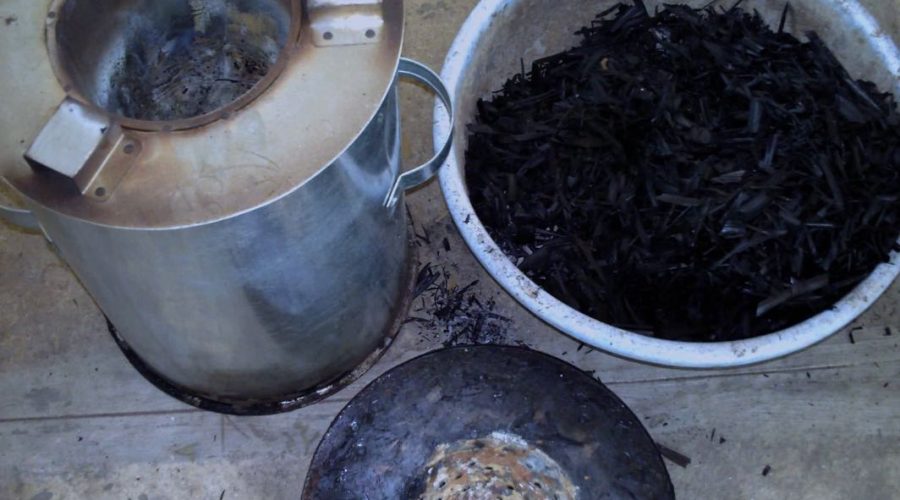
Biochar product from a gasifier – Source: Internet
Typically, SSA is measured using the BET (Brunauer–Emmett–Teller) gas adsorption method. However, BET equipment is costly and not widely accessible in developing countries or small-scale farms. Therefore, some studies suggest using water retention capacity as a proxy indicator for SSA and soil improvement efficiency. For example, the study “Water retention capacity of biochar and its effect on growth of maize” shows a strong correlation between water retention, surface area, and crop productivity.
1.1. Effect of Equivalence Ratio (ER)
Increasing the equivalence ratio (ER) (i.e., increasing air flow into the gasifier) will:
- Increase gasification temperature (e.g., reaching 882°C for OM5451 rice variety at ER = 0.4),
- Reduce biochar yield (due to more complete combustion),
- Improve water retention capacity of biochar (e.g., 5.7 ml/g dry char).
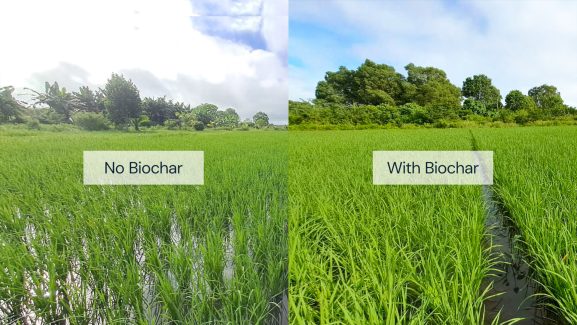
This contributes to enhanced plant growth, especially in sandy soils. Another study shows that adding biochar to soil can reduce irrigation needs by up to 40% (“Loading soil with biochar allows farmers to cut way back on irrigation”).
1.2. Role of Gasification Temperature and Post-Treatment
Higher gasification or pyrolysis temperatures result in biochar with superior soil amendment properties. According to “Physicochemical properties and morphology of biochars as affected by feedstock sources and pyrolysis temperatures”:
- When temperature increases from 350°C → 700°C:
- Cation Exchange Capacity (CEC), SSA, and microporosity more than double,
- pH buffering capacity improves significantly,
- Biochar produced at 700°C shows better soil improvement and pollutant adsorption.
Furthermore, if biochar is ozonized, its CEC can increase nearly tenfold, as reported in “Biochar Surface Oxygenation by Ozonization for Super High Cation Exchange Capacity.”
1.3. Phosphorus and Adsorption Capacity
The gasification process retains almost all phosphorus (P) in the biomass and increases its concentration in biochar. However, phosphorus is converted into less soluble forms, reducing leaching risks. As highlighted in “Biochar: a potential route for recycling of phosphorus in agricultural residues,” this is an effective way to recycle phosphorus from agricultural residues.
Notably:
- Biomass such as switchgrass pyrolyzed at 500–700°C shows strong phosphorus adsorption,
- At 300–500°C, it tends to release phosphorus.
This indicates that feedstock type and temperature are key factors determining biochar’s function in mitigating eutrophication in aquatic environments (“Biochar Phosphorus Sorption-Desorption”).
However, caution is required when gasifying animal manure at Level 4, as this may destroy its biological value if it could otherwise be used at Level 2 (e.g., for black soldier fly larvae or earthworm farming), which represents a higher-value pathway in circular ecosystems.
1.4. Biochar in Fermentation and Livestock Growth
Biochar plays a crucial role in improving fermentation efficiency and livestock growth at the farm level. According to Dr. T.R. Preston, adding biochar to cassava pulp fermentation enhances the conversion of crude protein into true protein.
His study (“Biochar improves the protein-enrichment of cassava pulp by yeast fermentation”) shows that biochar acts as a microbial carrier, accelerating starch fermentation and improving microbial development, thereby enhancing the nutritional value of fermented feed.
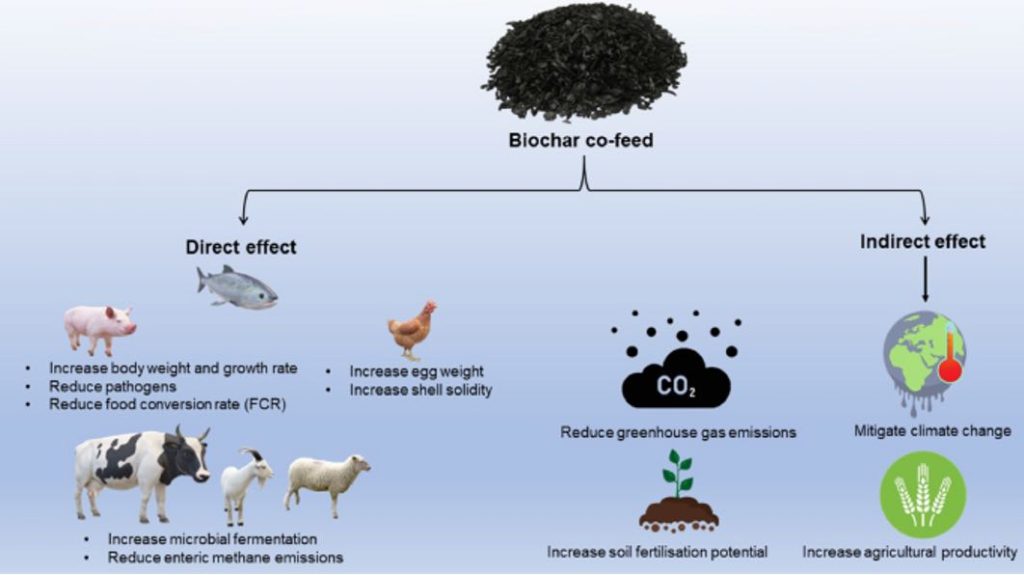
When included in animal diets, biochar demonstrates clear benefits:
- Indigenous cattle: 0.62% biochar → +25% weight gain, −22% methane (up to −41% with protein supplementation),
- Chickens: 0.6% biochar → +17% growth, especially with fermented feed,
- Pangasius fish: up to +36% growth, with reduced water pollutants (NH₃, NO₂⁻, PO₄³⁻, COD),
- Moo Lath pigs: 1% biochar → +20–23% weight gain,
- Goats: cassava + urea + water spinach + biochar → +41% intake, +46% nitrogen retention, +12% nitrogen bioavailability.
These results confirm biochar as an effective additive in ecological livestock systems.
Mechanisms of Action
Biochar functions as a prebiotic, providing a surface for biofilm formation—an ideal environment for beneficial gut microorganisms. It also adsorbs and neutralizes toxins such as:
- Mycotoxins,
- Polycyclic aromatic hydrocarbons (PAHs),
- Pesticide residues,
- Glyphosate,
- Dioxins.
These substances can otherwise impair digestion, immunity, and growth.
Additionally, rice husk biochar shows high adsorption capacity for antibiotics such as azithromycin and erythromycin, achieving up to 95% removal efficiency, thereby helping reduce antimicrobial resistance in livestock systems.
Conclusion
Biochar not only enhances animal growth, health, and reduces greenhouse gas emissions, but also lowers veterinary costs and improves product quality in integrated agricultural systems.
According to Dr. Preston, the application of biochar extends beyond feed additives to all microbiologically driven components of agricultural ecosystems. Its use in farming provides significant biological, environmental, and economic benefits, especially for smallholder farmers in developing countries.