BIOCHAR IN CONTAMINATED SOIL AND WATER TREATMENT
A low-cost, high-impact solution for environmental remediation and sustainable agriculture
As industrialization and intensive agriculture continue to expand, soil and water contamination have become critical global challenges. Heavy metals, pesticide residues, antibiotics, and excess nutrients are increasingly found in agricultural soils and water bodies, threatening food safety, ecosystem health, and human well-being. Traditional remediation methods—such as chemical treatments, excavation, or advanced filtration—are often costly, energy-intensive, and difficult to implement at scale, particularly in developing countries. In this context, biochar is gaining recognition as a versatile, low-cost, and sustainable remediation material capable of addressing multiple forms of pollution simultaneously.
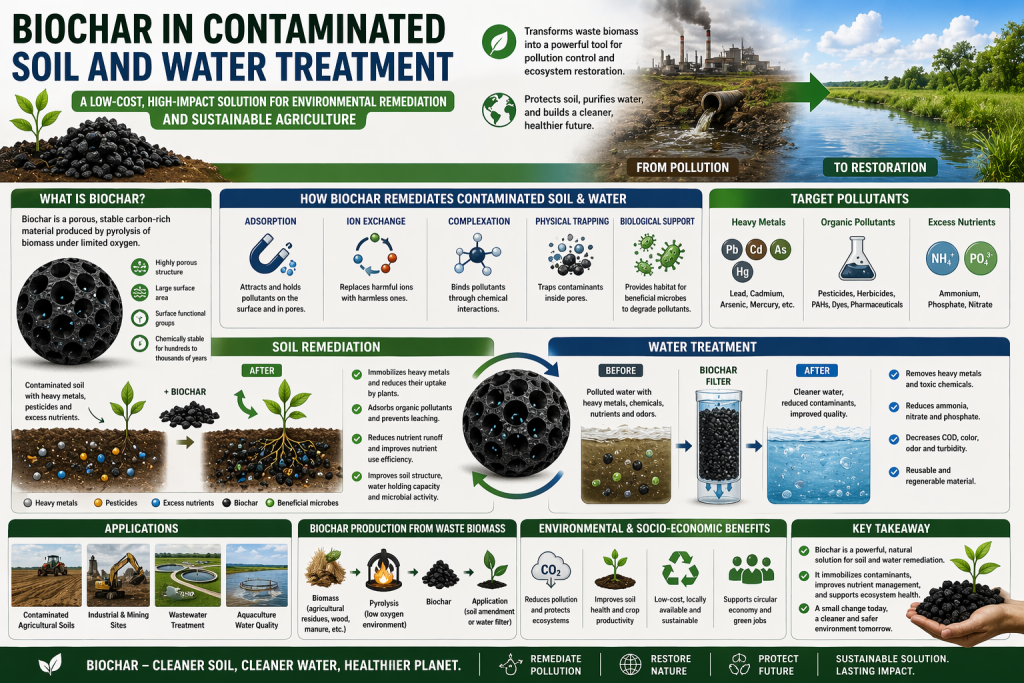
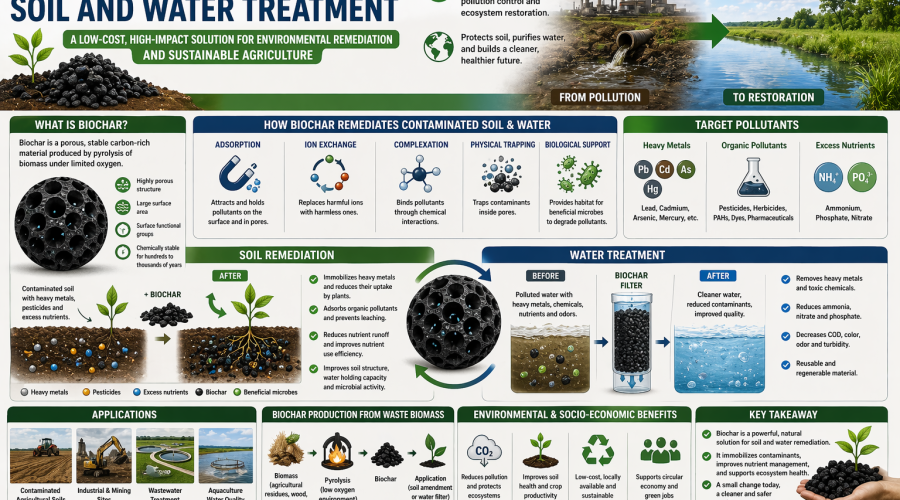
Biochar’s effectiveness in environmental remediation is rooted in its unique physicochemical properties. Produced through the thermal conversion of biomass under limited oxygen conditions, biochar is characterized by a highly porous structure, large surface area, and a variety of functional groups on its surface. These properties enable biochar to interact with contaminants through mechanisms such as adsorption, ion exchange, complexation, and physical trapping. As a result, biochar can immobilize pollutants, reduce their mobility, and limit their bioavailability in both soil and water systems.
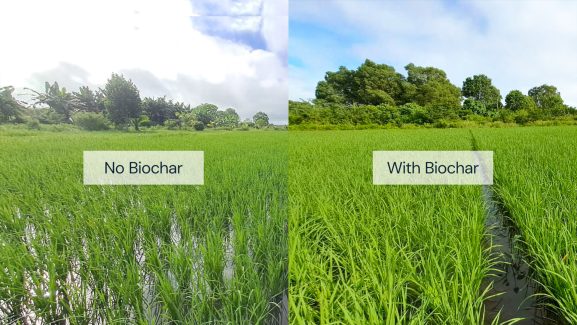
In contaminated soils, one of the most significant applications of biochar is the immobilization of heavy metals such as lead (Pb), cadmium (Cd), arsenic (As), and mercury (Hg). These metals pose serious risks due to their toxicity and persistence in the environment. When biochar is applied to contaminated soils, it can bind these metals through electrostatic attraction and surface complexation, effectively reducing their solubility and uptake by plants. This process does not remove the contaminants entirely but stabilizes them in a form that is less harmful, allowing for safer agricultural use of the land.
Another important function of biochar in soil remediation is its ability to adsorb organic pollutants, including pesticides, herbicides, and polycyclic aromatic hydrocarbons (PAHs). These compounds can persist in soils for long periods and may enter the food chain. Biochar’s hydrophobic surfaces and porous structure provide an ideal medium for capturing these molecules, preventing them from leaching into groundwater or being absorbed by crops. This is particularly relevant in regions with intensive farming practices, where chemical inputs are widely used.
Biochar also plays a critical role in managing nutrient pollution, especially excess nitrogen and phosphorus. In agricultural systems, overuse of fertilizers often leads to nutrient runoff, contributing to eutrophication in nearby water bodies. By adsorbing ammonium (NH₄⁺) and phosphate (PO₄³⁻), biochar helps retain nutrients in the soil, reducing losses and improving nutrient use efficiency. This not only enhances crop productivity but also protects aquatic ecosystems from nutrient overload.
In water treatment applications, biochar has shown strong potential as an alternative to conventional filtration materials such as activated carbon. While activated carbon is highly effective, it is often expensive and energy-intensive to produce. Biochar, on the other hand, can be produced locally from agricultural residues, making it more accessible and sustainable. In water systems, biochar can remove a wide range of contaminants, including heavy metals, organic pollutants, dyes, and even emerging contaminants such as antibiotics and pharmaceuticals.
One of the most promising applications of biochar in water treatment is in wastewater management, particularly in agricultural and aquaculture systems. When used as a filtration medium, biochar can reduce concentrations of ammonia, nitrite, and chemical oxygen demand (COD), improving overall water quality. In fish farming, for example, biochar can help maintain a healthier aquatic environment by stabilizing water chemistry and reducing toxic compounds, leading to better growth and survival rates.
Biochar’s performance in remediation can be further enhanced through modification and activation techniques. For instance, treating biochar with steam, acids, or ozone can increase its surface area and introduce additional functional groups, improving its adsorption capacity. In some cases, biochar can be engineered to target specific contaminants, making it a highly adaptable material for different environmental conditions.
An important advantage of biochar-based remediation is its compatibility with nature-based solutions. Unlike many conventional methods that rely on external inputs and infrastructure, biochar can be integrated directly into natural systems. For example, it can be combined with composting processes, constructed wetlands, or soil restoration programs. This allows for a more holistic approach to environmental management, where remediation is not a separate activity but part of a broader ecosystem strategy.
From an economic standpoint, biochar offers significant benefits. Its production can utilize locally available biomass, reducing waste and creating value-added products. The same material can serve multiple functions—soil amendment, pollutant adsorbent, and carbon storage—maximizing return on investment. For smallholder farmers and rural communities, this multifunctionality is particularly valuable, as it provides a practical and affordable solution to complex environmental challenges.
In the context of ESG and sustainability, biochar aligns strongly with environmental and social objectives. It contributes to pollution reduction, resource efficiency, and climate mitigation, while also supporting local livelihoods and circular economy models. Moreover, its application in contaminated environments can help restore degraded lands and improve food safety, which are critical components of sustainable development.
However, it is important to recognize that biochar is not a universal solution. Its effectiveness depends on several factors, including feedstock type, production conditions, application rate, and the nature of the contaminants. In some cases, improper use of low-quality biochar may introduce additional risks, such as residual toxins or heavy metals. Therefore, quality control, standardization, and site-specific assessment are essential for successful implementation.
Looking ahead, the role of biochar in environmental remediation is expected to grow as research advances and practical applications expand. With increasing pressure to address pollution, climate change, and resource constraints simultaneously, solutions that offer multiple benefits will become increasingly valuable. Biochar stands out in this regard, providing a bridge between waste management, environmental protection, and sustainable agriculture.
In conclusion, biochar represents a powerful tool for transforming contaminated soils and polluted water into safer, more productive systems. By immobilizing harmful substances, improving nutrient dynamics, and supporting biological processes, it enables a shift from reactive remediation to proactive ecosystem management. As part of an integrated sustainability strategy, biochar has the potential to play a key role in building cleaner, healthier, and more resilient agricultural landscapes.