BIOCHAR IN CIRCULAR AGRICULTURE MODELS
Closing the loop between waste, energy, soil, and food systems
As global agriculture faces increasing pressure from climate change, resource scarcity, and environmental degradation, the need for more sustainable and resilient production models has become urgent. One of the most promising approaches is circular agriculture, a system designed to minimize waste, maximize resource efficiency, and regenerate natural ecosystems. Within this framework, biochar is emerging as a critical enabling technology—one that not only fits into the circular model but actively strengthens it.
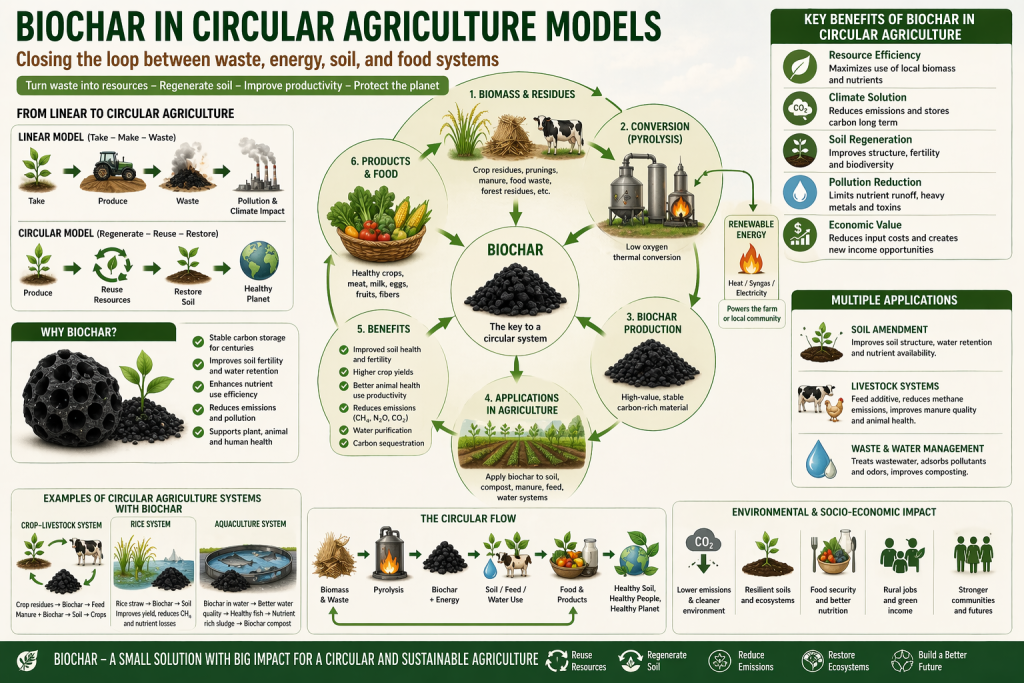
At its core, circular agriculture seeks to replace the traditional linear model of “take–make–waste” with a regenerative cycle where outputs from one process become inputs for another. In conventional farming systems, large volumes of agricultural residues—such as rice husks, straw, manure, and food waste—are often burned, discarded, or left to decompose inefficiently. This not only wastes valuable resources but also contributes to greenhouse gas emissions and environmental pollution. Biochar offers a pathway to transform these residues into a high-value, multifunctional product, effectively closing the loop.
The process begins with the conversion of biomass into biochar through pyrolysis or gasification. Unlike open burning, which releases carbon into the atmosphere, this controlled process stabilizes a significant portion of the carbon in solid form while also generating useful energy in the form of heat or syngas. This dual output—energy and biochar—creates an integrated system where waste is converted into both a renewable energy source and a soil-enhancing material.
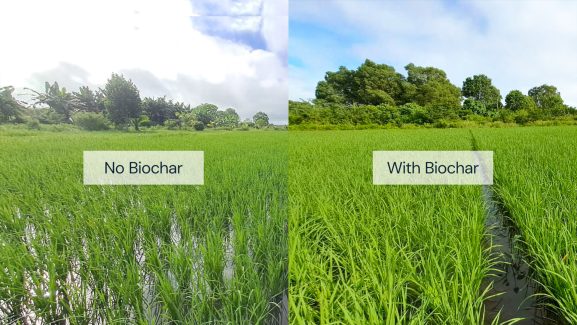
Once produced, biochar can be reintegrated into agricultural systems in multiple ways. When applied to soil, it improves fertility, enhances water retention, and supports microbial activity, leading to healthier crops and higher yields. When used in livestock systems, it can serve as a feed additive, improve digestion, reduce methane emissions, and enhance manure quality. In waste management, biochar can be used to treat organic residues, absorb odors, and reduce nutrient losses. These interconnected applications illustrate how biochar functions not as a single-use product, but as a system component within a broader circular ecosystem.
One of the most powerful aspects of biochar in circular agriculture is its ability to retain and recycle nutrients. In traditional systems, nutrients are often lost through leaching, volatilization, or runoff, leading to both economic losses and environmental harm. Biochar acts as a nutrient “bank,” capturing and holding essential elements such as nitrogen and phosphorus, and releasing them gradually over time. This reduces the need for synthetic fertilizers and ensures that nutrients remain within the production system, supporting long-term soil fertility.
In integrated farming models, biochar can connect different subsystems into a cohesive whole. For example, crop residues can be converted into biochar, which is then used to improve soil or added to livestock feed. The resulting manure, enriched with biochar, becomes a higher-quality organic fertilizer that can be returned to the fields. In some systems, biochar is also used in composting processes, where it enhances microbial activity and accelerates decomposition, producing nutrient-rich compost more efficiently.
This closed-loop approach not only improves resource efficiency but also reduces environmental impacts. By minimizing waste and emissions, circular agriculture systems that incorporate biochar can significantly lower their carbon footprint. At the same time, the carbon stored in biochar represents a form of long-term sequestration, contributing to climate change mitigation. This combination of emission reduction and carbon storage makes biochar a key component in achieving net-zero or even carbon-negative agricultural systems.
Another important dimension of biochar in circular agriculture is its role in decentralized and scalable solutions. Unlike many industrial technologies that require large-scale infrastructure, biochar can be produced at various scales—from small farm-level units to larger commercial facilities. This flexibility allows farmers, cooperatives, and local communities to adopt biochar-based systems according to their specific needs and resources. In rural areas, this can create new economic opportunities, turning agricultural waste into a source of income and energy.
From a socio-economic perspective, biochar supports the transition toward more resilient and inclusive agricultural systems. By reducing dependence on external inputs such as chemical fertilizers and fossil fuels, farmers can lower their production costs and increase their autonomy. At the same time, the integration of biochar into circular models can create new value chains, including the production, processing, and application of biochar, as well as participation in carbon markets.
In the context of ESG (Environmental, Social, and Governance) and sustainable development, biochar-based circular agriculture aligns strongly with key objectives. Environmentally, it promotes resource efficiency, reduces pollution, and enhances ecosystem health. Socially, it supports rural livelihoods and food security. From a governance perspective, it provides measurable outcomes in terms of emissions reduction, carbon sequestration, and resource management, making it suitable for reporting and certification frameworks.
However, the successful implementation of biochar in circular agriculture requires careful design and coordination. It is not enough to produce biochar; it must be integrated into a system where its multiple functions can be fully utilized. This involves understanding local conditions, selecting appropriate feedstocks, optimizing production processes, and aligning applications with specific agricultural needs. Education, training, and technical support are essential to ensure that farmers and stakeholders can effectively adopt and benefit from these systems.
Looking forward, the integration of biochar into circular agriculture represents a significant step toward a more sustainable food system. It demonstrates how waste can be transformed into value, how carbon can be managed as a resource rather than a liability, and how agricultural systems can be designed to regenerate rather than deplete natural capital. As global challenges continue to intensify, such approaches will become increasingly important in ensuring food security, environmental sustainability, and economic resilience.
In conclusion, biochar is more than just a soil amendment—it is a catalyst for systemic change. By enabling the transformation of waste into resources, connecting different components of agricultural systems, and supporting both productivity and sustainability, biochar plays a central role in the transition toward circular agriculture. It offers a practical and scalable pathway to close the loop between production and regeneration, paving the way for a more balanced and resilient future in farming.