
BIOCHAR – A FOUNDATION FOR BIOLOGICAL CARBON CREDITS
Turning agricultural systems into measurable, verifiable carbon removal solutions
As the global economy accelerates toward net-zero commitments, the demand for high-quality carbon credits has grown rapidly. However, not all carbon credits are created equal. Increasing scrutiny from regulators, investors, and buyers has shifted attention toward carbon removal solutions—those that actively extract carbon dioxide (CO₂) from the atmosphere and store it in a stable, long-term form. Among these solutions, biochar is emerging as one of the most credible and scalable pathways, offering a unique combination of scientific robustness, permanence, and co-benefits in agriculture.
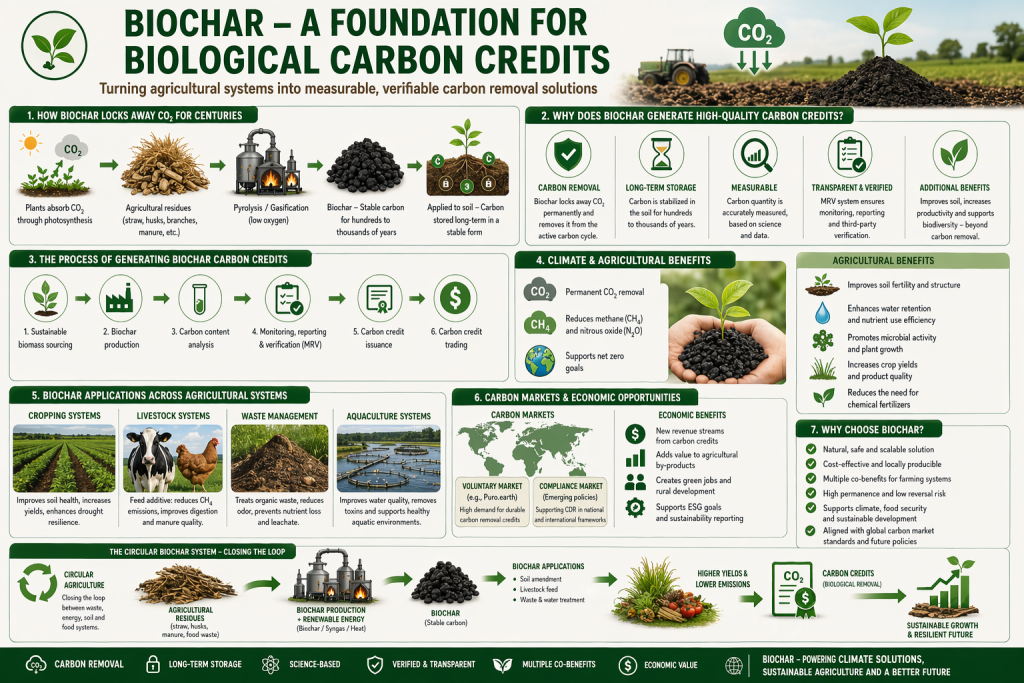
At its core, the value of biochar in carbon markets lies in its ability to transform short-lived biological carbon into a durable carbon sink. Through photosynthesis, plants absorb CO₂ from the atmosphere and convert it into biomass. Under natural conditions, this carbon is eventually released back into the atmosphere through decomposition or burning. However, when biomass is converted into biochar via pyrolysis or gasification, a significant portion of that carbon is stabilized into an aromatic structure that resists degradation. Once applied to soil, this carbon can remain sequestered for hundreds to thousands of years, effectively removing CO₂ from the active carbon cycle.
This characteristic places biochar within the category of carbon dioxide removal (CDR) technologies—an increasingly important pillar of global climate strategies. Unlike emission reduction measures, which aim to lower the rate of emissions, CDR solutions provide a mechanism to reverse past emissions. In a world where many sectors—such as aviation, heavy industry, and agriculture—will continue to emit greenhouse gases in the near term, carbon removal is essential to achieving net-zero and, ultimately, net-negative outcomes.
One of the key advantages of biochar as a carbon credit solution is its measurability and traceability. The amount of carbon sequestered in biochar can be quantified based on feedstock characteristics, production conditions, and carbon content analysis. Modern monitoring, reporting, and verification (MRV) systems allow for precise tracking of the entire lifecycle—from biomass sourcing to biochar application in soil. This level of transparency is critical in ensuring the credibility of carbon credits and addressing concerns about greenwashing.
In addition to measurability, permanence is a defining strength of biochar. Many nature-based solutions, such as afforestation or soil carbon sequestration, face challenges related to reversibility—carbon stored in trees or soils can be released through fires, land-use changes, or natural degradation. Biochar, by contrast, is highly stable due to its chemical structure. This durability significantly reduces the risk of carbon reversal, making biochar-based credits particularly attractive to buyers seeking long-term climate impact.
Another important dimension is additionality, a key criterion in carbon markets. For a project to generate valid carbon credits, it must demonstrate that the carbon removal would not have occurred without the project. Biochar projects often meet this requirement because they involve the intentional conversion of biomass that would otherwise decompose or be burned. By diverting this biomass into a controlled process that stabilizes carbon, biochar projects create a clear and measurable climate benefit beyond business-as-usual practices.
Beyond its carbon removal function, biochar delivers a wide range of co-benefits that enhance its overall value proposition. When applied to soil, biochar improves fertility, water retention, and microbial activity, leading to increased agricultural productivity. In livestock systems, it can reduce methane emissions and improve feed efficiency. In waste management, it helps stabilize organic residues and reduce pollution. These additional benefits align closely with broader sustainability goals, making biochar an attractive solution not only for carbon markets but also for ESG-driven investments.
From a financial perspective, biochar-based carbon credits are gaining traction in both voluntary and compliance markets. Platforms such as Puro.earth and emerging methodologies under Verra are actively developing frameworks to certify and trade biochar credits. These credits are often categorized as premium carbon removal credits due to their high permanence and verifiability. As demand for such credits increases, biochar projects have the potential to generate significant revenue streams, particularly for agricultural producers and project developers.
For countries like Vietnam, the opportunity is especially compelling. With abundant agricultural residues—such as rice husks, coffee shells, and crop by-products—the raw materials for biochar production are readily available. At the same time, the country faces challenges related to agricultural emissions, soil degradation, and climate vulnerability. By integrating biochar into agricultural systems and linking it to carbon markets, Vietnam can simultaneously address these challenges while creating new economic opportunities.
However, realizing this potential requires a robust ecosystem of standards, technology, and capacity building. High-quality biochar production must be ensured through controlled processes that minimize emissions and maximize carbon stability. Standardized methodologies are needed to quantify carbon removal accurately and consistently. In addition, farmers, cooperatives, and enterprises must be equipped with the knowledge and tools to participate effectively in carbon markets.
Another critical factor is the development of integrated project models. Biochar should not be viewed in isolation, but as part of a broader system that includes biomass supply chains, energy production, agricultural application, and carbon credit certification. By designing projects that capture value across this entire chain, stakeholders can maximize both environmental and economic returns.
Looking ahead, biochar has the potential to become a cornerstone of biological carbon markets. As the world moves beyond simple emission reduction targets toward comprehensive carbon management strategies, solutions that combine removal, storage, and co-benefits will be in high demand. Biochar fits this profile exceptionally well, offering a rare combination of scalability, reliability, and multifunctionality.
In conclusion, biochar represents a powerful bridge between agriculture and climate finance. It transforms waste into a resource, emissions into opportunities, and soils into carbon sinks. More importantly, it provides a tangible, measurable pathway for farmers and enterprises to participate in the global transition to net zero. As carbon markets continue to evolve, biochar stands out not only as a technical solution, but as a strategic platform for building a more sustainable and resilient future.

SREYPOUV TAN
May 27, 2026 at 3:51 amI am a founder of Agro Agape, we turning farm waste into biochar and developing biochar into biofertilizer for farmers using instead of synthetic fertilizer.
May I know more about your project?
admin
May 31, 2026 at 9:15 amHi Tan,
We develop an full scope project from biochar production to biochar carbon credit. And we are focusing into Vietnam market. But we will deploy in full Mekong countries.
We are happy to discuss more with you about your project to see what we can do together. Please contact us by email: office@mekongbiochar.com
Thanks