Life Cycle Assessment (LCA) of Biochar Systems
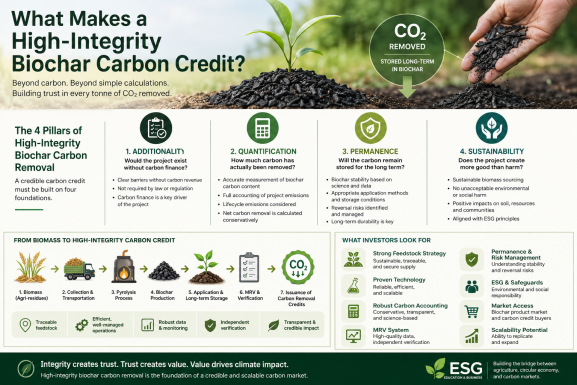
Life Cycle Assessment (LCA) is a critical analytical framework used to evaluate the full environmental impact of biochar systems from cradle to grave. As biochar is increasingly positioned as a carbon dioxide removal (CDR) solution, it is essential to move beyond assumptions and quantify its actual climate performance. LCA provides this rigor by accounting for all emissions and environmental interactions across the entire value chain—from biomass sourcing to long-term carbon storage—ensuring that biochar systems are not only theoretically carbon-negative but demonstrably so in practice.
At its core, LCA in biochar systems begins with the feedstock stage, where biomass such as rice husks, wood residues, or agricultural waste is collected, processed, and transported. While these materials are often considered low-value or waste streams, their handling still involves energy use and associated emissions. The sustainability of feedstock sourcing is also a key consideration; using true waste biomass strengthens the environmental profile, whereas dedicated biomass production may introduce land-use and carbon opportunity costs. Therefore, the upstream phase plays a decisive role in determining whether the system contributes positively to climate mitigation.
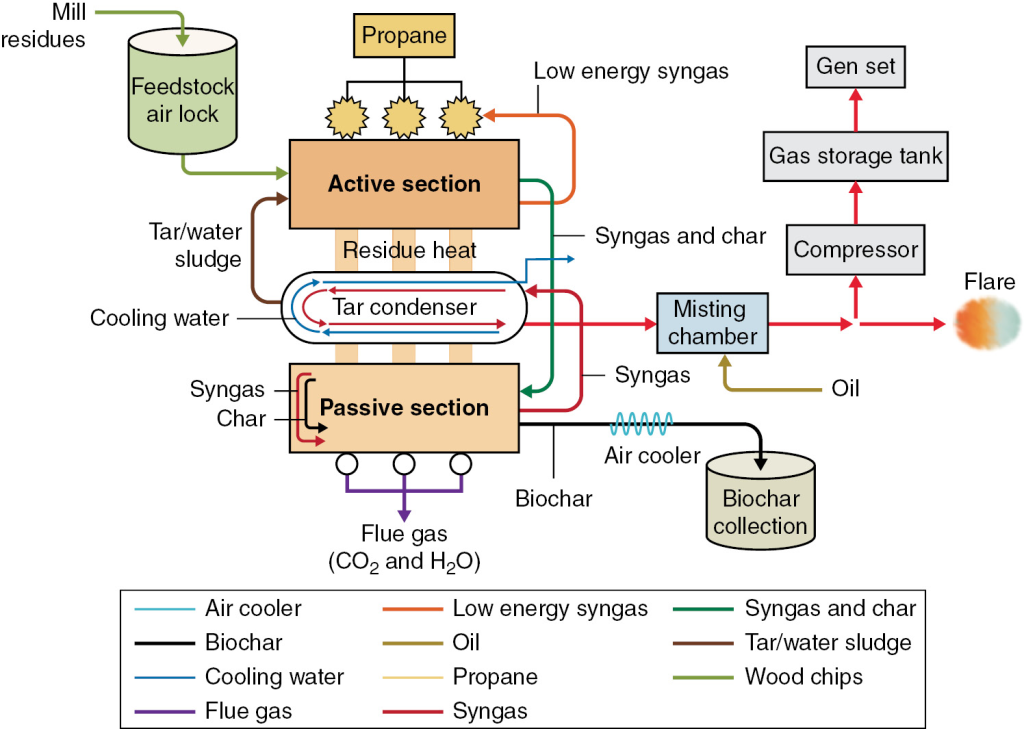
The next stage is the thermochemical conversion process, typically through pyrolysis or gasification. This is the technological core of the system, where biomass is transformed into biochar, along with co-products such as syngas and bio-oil. LCA evaluates not only the efficiency of carbon conversion into stable biochar but also the energy balance of the process. Systems that utilize syngas internally to sustain operations or export renewable energy can significantly improve their environmental performance by reducing reliance on fossil fuels. Conversely, inefficient systems with high external energy inputs may reduce or even negate the carbon removal benefit.
Following production, the application phase determines how biochar contributes to long-term carbon storage and environmental co-benefits. When applied to soil, biochar can remain stable for hundreds to thousands of years, effectively locking carbon away from the atmosphere. In addition to sequestration, LCA also considers indirect benefits such as improved soil fertility, reduced fertilizer use, enhanced water retention, and lower emissions of nitrous oxide and methane. These co-benefits can substantially enhance the overall climate impact of the system, although their inclusion depends on the methodological framework applied.
A key strength of LCA is its ability to integrate these different components into a single metric: net carbon removal. This is calculated by combining the amount of carbon stored in biochar with avoided emissions—such as those from preventing biomass burning or displacing fossil energy—and subtracting all lifecycle emissions associated with the system. The result is typically expressed in tons of CO₂ equivalent (tCO₂e). Well-optimized biochar systems can achieve net-negative emissions in the range of 2 to 3 tons of CO₂e removed per ton of biochar produced, although this figure can vary significantly depending on system design and operating conditions.
Importantly, LCA is not just a reporting tool but also a design and optimization instrument. By analyzing the contribution of each stage to the overall environmental footprint, developers can identify opportunities to improve performance. For example, reducing transport distances, selecting low-moisture feedstocks, optimizing reactor efficiency, or maximizing energy recovery can all enhance the net carbon benefit. In this sense, LCA enables a shift from static assessment to dynamic system engineering, where environmental performance becomes a controllable variable rather than a fixed outcome.
LCA also plays a central role in carbon credit certification and ESG reporting. Most biochar carbon methodologies—such as those developed by leading carbon registries—require LCA-based calculations to verify net carbon removal. This ensures consistency, transparency, and comparability across projects. For investors and corporate buyers, LCA provides confidence that the claimed climate benefits are real, measurable, and aligned with international standards. In a market increasingly concerned with greenwashing, this level of rigor is indispensable.
However, conducting LCA for biochar systems is not without challenges. Data availability, methodological differences, and site-specific variability can all influence results. For instance, assumptions about carbon stability, system boundaries, or avoided emissions can lead to different outcomes across studies. This highlights the need for standardized methodologies and robust data collection systems, particularly as biochar projects scale and enter global carbon markets.
Looking ahead, the integration of LCA with digital technologies is expected to significantly enhance its accuracy and scalability. Real-time monitoring systems, sensor-based data collection, and digital MRV platforms can enable continuous LCA updates, reducing uncertainty and verification costs. This evolution toward dynamic LCA will be particularly important for large-scale deployment, where thousands of decentralized biochar systems need to be monitored and assessed efficiently.
In conclusion, Life Cycle Assessment is the scientific foundation that underpins the credibility of biochar as a climate solution. It transforms biochar from a promising concept into a quantifiable and verifiable carbon removal pathway by capturing the full environmental footprint of the system. As the world moves toward net-zero and beyond, LCA will play an essential role in ensuring that biochar delivers real, measurable, and scalable impact—both for the climate and for sustainable agricultural development.