Biochar vs Compost: Which Is the Better Choice for Your Home Vegetable Garden?
For many home gardeners, one of the most common questions is surprisingly simple:
Should I use compost or biochar?
Both are widely promoted as sustainable soil amendments. Both can improve plant growth. Both are environmentally friendly alternatives to excessive chemical fertilizer use.
Yet they are fundamentally different products that work in very different ways.
The reality is that biochar and compost are not competitors. They solve different problems within the soil ecosystem. Understanding how each one functions can help gardeners achieve healthier vegetables, better yields, and more resilient soils.
Understanding the Difference
Before deciding which option is best, it is important to understand what each material actually does.
Compost: Food for the Soil
Compost is produced through the biological decomposition of organic materials such as food scraps, leaves, grass clippings, crop residues, and animal manure.
A mature compost contains:
- Nitrogen
- Phosphorus
- Potassium
- Micronutrients
- Beneficial microorganisms
- Humus and organic matter
In simple terms, compost acts as a nutrient source. It feeds plants and soil biology directly.
When gardeners apply compost, they often see relatively quick improvements in plant growth because nutrients become available almost immediately.
Biochar: Infrastructure for the Soil
Biochar is a carbon-rich material produced by heating biomass under oxygen-limited conditions through pyrolysis.
Unlike compost, biochar contains very little plant nutrition. Instead, its value lies in its highly porous structure, which acts like a microscopic sponge capable of retaining water, nutrients, and beneficial microorganisms.
Think of compost as food.
Think of biochar as a house.
Compost feeds the soil ecosystem, while biochar provides the long-term infrastructure that helps the ecosystem function more efficiently.
Which One Improves Plant Growth Faster?
If your goal is to improve vegetable growth this season, compost is usually the clear winner.
Because compost contains readily available nutrients, vegetables can quickly benefit from:
- Increased nitrogen availability
- Better microbial activity
- Improved root development
- Faster vegetative growth
Biochar, on the other hand, often works more slowly. Its primary benefits emerge over months or years as it improves soil structure and nutrient retention.
For beginner gardeners seeking immediate results, compost typically delivers more visible improvements during the first growing season.
Which One Improves Soil Long-Term?
This is where biochar becomes extremely attractive.
Compost continuously decomposes. Most of its benefits gradually decline within one to three years as organic matter breaks down naturally.
Biochar is different.
Because it contains highly stable carbon, it can remain in soil for hundreds or even thousands of years. Scientists increasingly recognize biochar as both a soil amendment and a carbon sequestration technology.
For gardeners focused on building soil quality over the long term, biochar offers advantages that compost alone cannot provide.
Water Retention: Which Performs Better?
Water management has become increasingly important as climate variability increases.
Research and field applications consistently show that biochar can significantly improve soil water-holding capacity due to its porous structure. It effectively acts as a reservoir that stores moisture and releases it gradually to plant roots.
This can be especially valuable for:
- Raised beds
- Sandy soils
- Container gardens
- Drought-prone regions
Compost also improves water retention, but its effect is generally less durable because the material continues decomposing over time.
Which Is More Cost Effective?
For small vegetable gardens, compost is usually the more economical choice.
Many gardeners can produce compost at home from kitchen scraps and garden waste at little or no cost.
Biochar production requires specialized equipment or purchasing commercial products, which often involve higher upfront costs.
However, biochar is typically a one-time or infrequent investment because it remains effective for decades.
From a long-term perspective, the economics become more balanced.
A Common Mistake: Using Fresh Biochar Alone
One of the biggest mistakes new users make is applying fresh biochar directly to soil.
Fresh biochar can temporarily absorb nutrients from the surrounding environment before reaching equilibrium. This may reduce nutrient availability for plants in the short term.
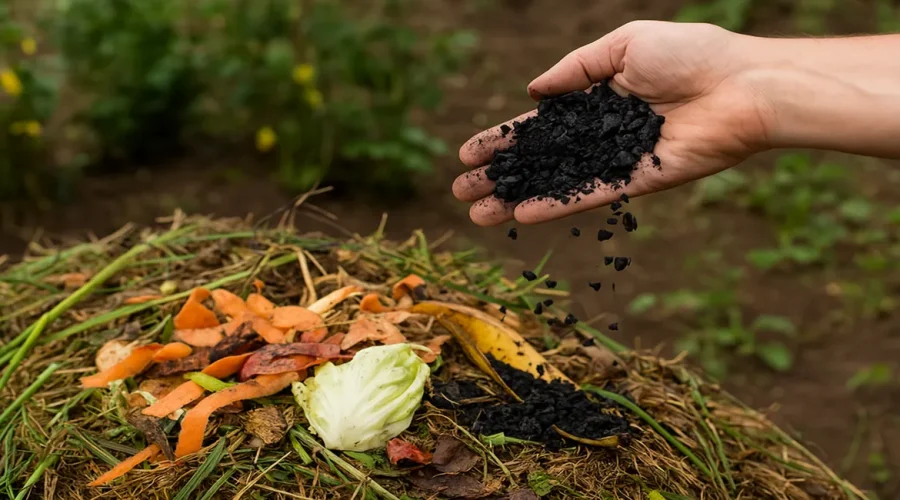
For this reason, experienced growers often recommend “charging” biochar before use.
Charging involves mixing biochar with:
- Compost
- Compost tea
- Animal manure
- Organic fertilizers
This allows the pores of the biochar to become saturated with nutrients and beneficial microbes before application.
The Best Solution: Biochar + Compost
Interestingly, the debate between biochar and compost may be asking the wrong question.
The most successful gardeners increasingly use both.
When combined, each material compensates for the other’s weaknesses:
| Function | Compost | Biochar |
|---|---|---|
| Provides nutrients | Excellent | Low |
| Supports microbial activity | Excellent | Excellent |
| Improves water retention | Good | Excellent |
| Long-term soil improvement | Moderate | Excellent |
| Carbon sequestration | Limited | Excellent |
| Immediate crop response | Excellent | Moderate |
The combination creates a powerful synergy.
Compost provides nutrients and biological activity.
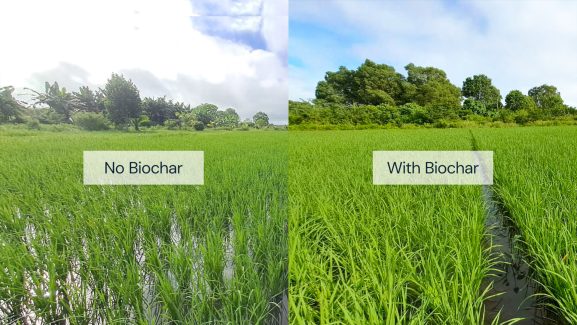
Biochar stores those nutrients, protects microorganisms, reduces nutrient losses, and improves long-term soil structure. Field observations frequently report greater benefits from combining the two than from using either one independently.
What Should a Small Vegetable Garden Use?
If you are starting a new vegetable garden, the recommendation is straightforward:
Choose Compost If:
- You want immediate plant growth.
- You have limited budget.
- Your soil is severely nutrient deficient.
- You are growing short-cycle vegetables.
Choose Biochar If:
- You want long-term soil improvement.
- Your soil dries out quickly.
- You want to reduce fertilizer losses.
- You are interested in regenerative gardening and carbon sequestration.
Choose Both If:
- You want the best overall results.
- You are building a productive garden for many years.
- You want healthier soil, better water retention, and stronger crop performance.
Final Thoughts
For decades, gardeners have searched for the perfect soil amendment.
The truth is that neither compost nor biochar is a miracle product.
Compost excels at feeding the soil.
Biochar excels at strengthening the soil.
When used together, they create a living system that is more productive, more resilient, and more sustainable than either material alone.
For a small vegetable garden, the question should not be “Biochar or compost?”
The better question is:
“How can I combine biochar and compost to build healthier soil for years to come?”