BIOCHAR AS A CARBON REMOVAL TECHNOLOGY (CDR)
Transforming biomass into durable carbon sinks for a net-zero future
As global climate targets tighten, reducing emissions alone is no longer sufficient. Achieving net-zero—and ultimately net-negative—emissions requires the deployment of Carbon Dioxide Removal (CDR) technologies that actively extract CO₂ from the atmosphere and store it in stable forms. Among the emerging portfolio of CDR solutions, biochar stands out as one of the most practical, scalable, and verifiable approaches, particularly in the context of agriculture and biomass-rich economies.
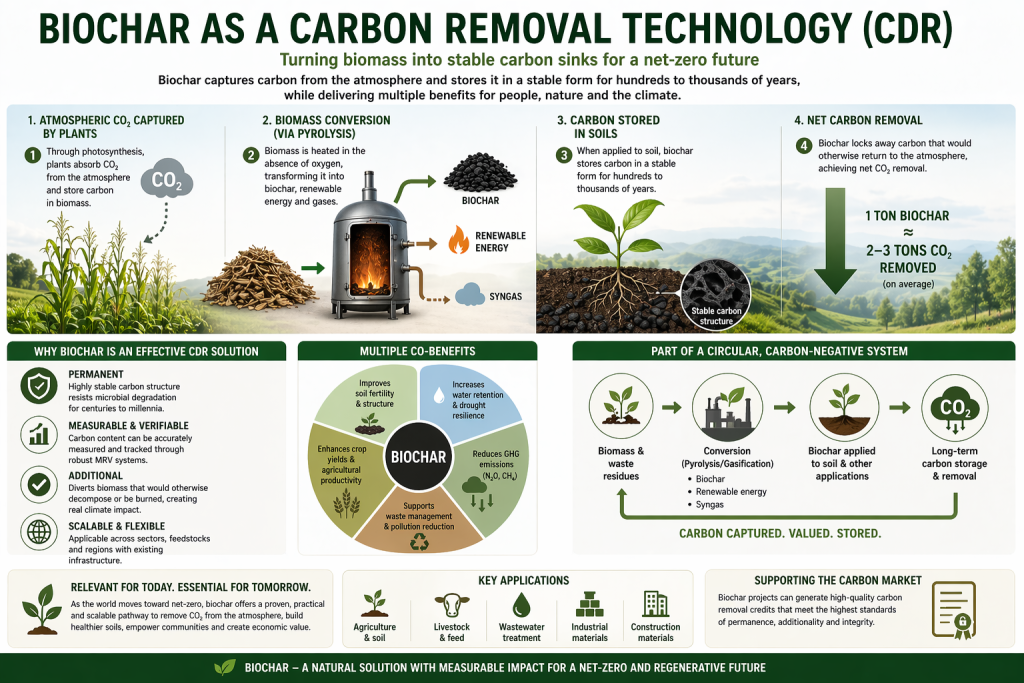
At its core, biochar represents a bridge between the natural carbon cycle and engineered carbon storage. Through photosynthesis, plants absorb atmospheric CO₂ and convert it into biomass. Under conventional conditions, this carbon is eventually released back into the atmosphere through decomposition or open burning. However, when biomass is subjected to controlled thermochemical processes such as pyrolysis, a significant fraction of this carbon is transformed into a highly stable, aromatic structure—biochar. When applied to soil, this carbon becomes resistant to microbial degradation and can remain sequestered for hundreds to thousands of years.
This transformation is what qualifies biochar as a true CDR solution. Unlike emission reduction strategies, which aim to prevent future emissions, biochar-based systems remove existing CO₂ from the atmosphere and lock it into a durable carbon pool. Depending on feedstock type and process efficiency, one ton of biochar can represent the net removal of approximately 2 to 3 tons of CO₂ equivalent, making it one of the more carbon-efficient negative emissions pathways available today.
One of the defining advantages of biochar in the CDR landscape is its permanence. Many nature-based solutions—such as afforestation or soil organic carbon enhancement—face risks of reversal due to fire, land-use change, or biological decomposition. Biochar, by contrast, consists of condensed aromatic carbon structures that are highly resistant to degradation. This chemical stability significantly reduces the likelihood of carbon being re-released into the atmosphere, addressing one of the key concerns in carbon accounting and crediting systems.
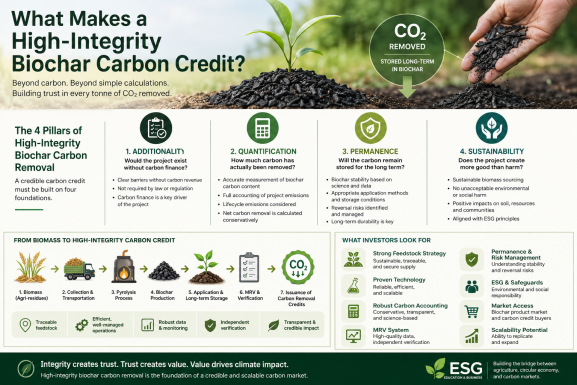
Equally important is the measurability and traceability of biochar carbon. The carbon content of biochar can be quantified through standardized laboratory analysis, while production conditions and feedstock inputs can be monitored and recorded. This allows for robust Monitoring, Reporting, and Verification (MRV) frameworks, which are essential for generating high-integrity carbon credits. Compared to more diffuse or difficult-to-measure CDR pathways, biochar offers a relatively transparent and auditable carbon flow from biomass to stable storage.
Another critical factor is additionality—the requirement that carbon removal would not have occurred in the absence of the project. Biochar systems typically meet this criterion by diverting biomass that would otherwise decompose or be burned, both of which would release CO₂ and other greenhouse gases. By converting this biomass into stable carbon, biochar projects create a clear and quantifiable climate benefit beyond business-as-usual scenarios.
Beyond carbon removal, biochar delivers a wide range of co-benefits that enhance its overall value. When applied to soil, it improves water retention, nutrient availability, and microbial activity, leading to increased agricultural productivity and resilience. It can also reduce emissions of nitrous oxide (N₂O) and methane (CH₄), further contributing to climate mitigation. In waste management systems, biochar helps stabilize organic residues and reduce pollution. These co-benefits make biochar particularly attractive in integrated sustainability strategies, where environmental, economic, and social outcomes are interconnected.
From a systems perspective, biochar enables the development of carbon-negative value chains. Agricultural residues, forestry by-products, and organic waste streams can be converted into both renewable energy (through syngas or heat) and biochar. The energy can be used locally or fed into industrial processes, while the biochar is returned to soils or used in other applications. This creates a circular model in which carbon is continuously captured, utilized, and stabilized, rather than emitted.
In the context of carbon markets, biochar is gaining recognition as a source of high-quality carbon removal credits. Certification platforms and standards are increasingly incorporating biochar methodologies, recognizing its permanence and measurability. These credits are often positioned at the premium end of the market, reflecting their durability and low risk of reversal. For project developers, this opens up new revenue streams that can help finance biochar production and deployment.
For countries with abundant biomass resources, such as Vietnam, the potential is particularly significant. Agricultural residues like rice husks, coffee shells, and crop by-products are widely available and often underutilized. By converting these materials into biochar and linking the process to carbon credit generation, it is possible to create locally anchored, globally relevant climate solutions. This not only contributes to national climate goals but also supports rural development and resource efficiency.
However, scaling biochar as a CDR solution requires overcoming several challenges. These include the need for standardized production technologies, consistent quality control, and clear regulatory frameworks for carbon accounting. Investment in infrastructure, capacity building, and market development is also essential. Ensuring that biochar systems are environmentally and socially responsible—particularly in terms of feedstock sourcing and land use—is critical to maintaining credibility.
Looking ahead, biochar is well positioned to play a central role in the evolving CDR ecosystem. Its ability to combine carbon removal, agricultural productivity, waste valorization, and energy generation makes it uniquely versatile. As climate policies become more stringent and carbon markets mature, solutions that deliver multiple benefits with high integrity will be in increasing demand.
In conclusion, biochar represents a compelling pathway for transforming agriculture and biomass systems into active carbon removal platforms. By stabilizing carbon in a durable form and integrating it into productive land systems, biochar goes beyond mitigation—it offers a practical route toward regeneration and climate restoration. As part of a broader portfolio of CDR technologies, it has the potential to make a meaningful contribution to global net-zero ambitions while delivering tangible benefits on the ground.