What Makes a High-Integrity Biochar Carbon Credit?
What Makes a High-Integrity Biochar Carbon Credit?
Beyond Carbon: Understanding the Foundations of Credible Biochar Carbon Removal
The Biochar industry is entering an important new phase.
For many years, Biochar was primarily discussed as an agricultural amendment, a soil improvement product, a biomass management solution, or a technology for converting agricultural residues into useful materials.
Today, Biochar is increasingly becoming part of a much larger market: Carbon Dioxide Removal (CDR).
This transition creates a significant opportunity.
A Biochar project can potentially generate revenue from the sale of Biochar products while also creating value through verified Carbon Removal Credits. For agricultural businesses, biomass owners, technology providers, investors and project developers, this opens the door to a new class of climate-related assets.
But there is also a major challenge.
Not every tonne of Biochar represents one tonne of CO₂ removed from the atmosphere.
And not every Carbon Removal Credit has the same level of environmental integrity.
As the Biochar Carbon Removal market grows, buyers and investors will increasingly ask:
How do we know that this carbon credit represents real, additional, measurable and durable carbon removal?
This question is at the heart of the emerging Carbon Removal market.
A 2026 report from the University of Bristol and CO2RE, Biochar Carbon Removal Standards: A comparative assessment of the EU CRCF, ICVCM and Article 6.4, examines the standards and integrity frameworks being developed around Biochar Carbon Removal. The report compares the European Union’s Carbon Removal Certification Framework (CRCF), the Integrity Council for the Voluntary Carbon Market’s Core Carbon Principles (ICVCM CCPs), and the Paris Agreement Article 6.4 mechanism.
The central lesson is clear:
A credible Biochar Carbon Removal project needs much more than a pyrolysis plant and a carbon calculation.
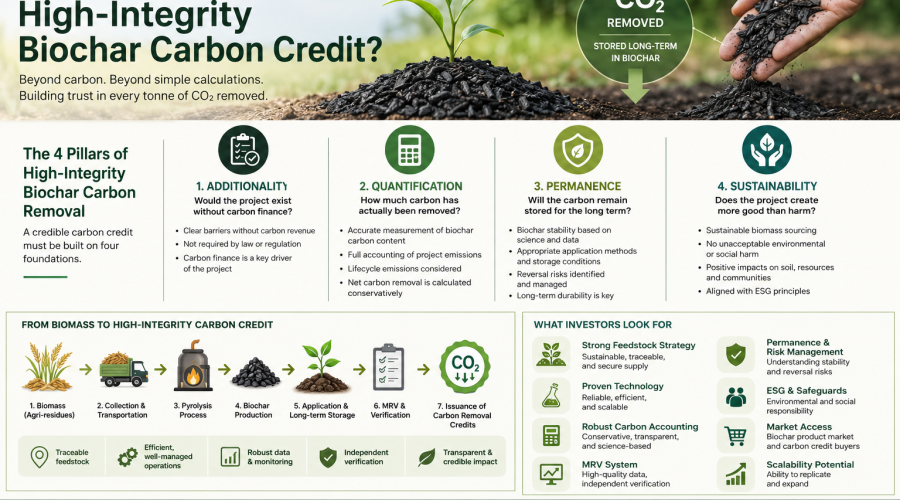
It needs a robust system for demonstrating additionality, quantification, permanence and sustainability.
1. What Is a Biochar Carbon Credit?
Before discussing integrity, it is important to distinguish between Biochar and Biochar Carbon Removal.
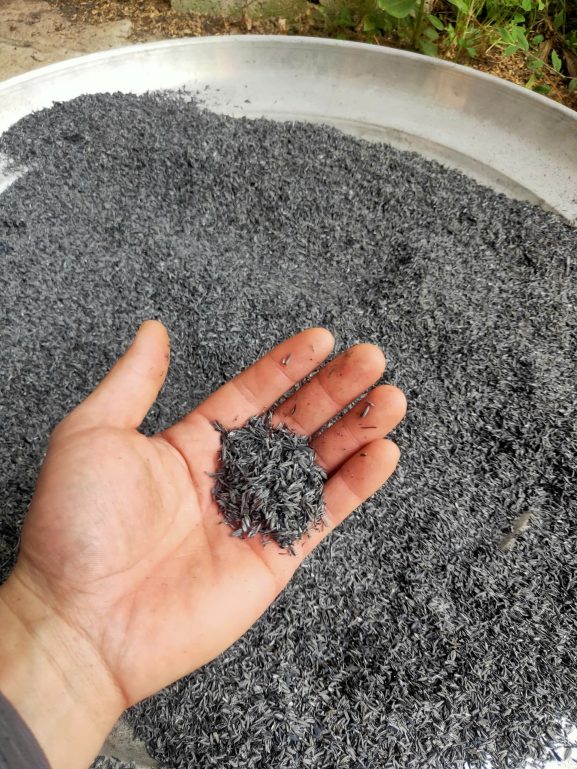
Biochar is a carbon-rich material produced through the thermal conversion of biomass, commonly using pyrolysis.
The feedstock may include:
- Rice husks
- Coconut shells
- Coffee residues
- Sugarcane bagasse
- Cashew shells
- Forestry residues
- Sawdust
- Other agricultural biomass
During pyrolysis, part of the carbon originally contained in biomass is converted into a more stable carbon structure.
If the resulting Biochar is placed in a suitable long-term storage environment, such as soil or certain durable products, a portion of that carbon may remain stored for an extended period.
This is the basis of Biochar Carbon Removal.
However, the calculation is not simply:
Carbon in biomass → Carbon in Biochar → Carbon credit
A Carbon Removal project must account for the emissions associated with the entire relevant activity.
For example:
Feedstock collection → Transportation → Drying → Pyrolysis → Energy consumption → Biochar processing → Application → Long-term storage
If the project emits significant greenhouse gases during these activities, those emissions reduce the net amount of carbon removed.
Therefore:
Gross carbon stored is not the same as net carbon removed.
This distinction is fundamental to carbon market integrity.
2. Why Carbon Credit Integrity Matters
A carbon credit is ultimately a claim about climate impact.
If a project issues a credit representing one tonne of CO₂ removal, the buyer should be able to trust that approximately one tonne of atmospheric CO₂ has been removed and stored according to the applicable methodology and standard.
If this cannot be demonstrated, the credit may have limited climate value.
This is why the concept of carbon integrity has become increasingly important.
High-integrity Carbon Removal should address questions such as:
Is the removal real?
The carbon must actually be removed and stored.
Is it additional?
The removal should not simply represent an activity that would have happened anyway under the relevant framework.
Is it measurable?
The quantity of removal needs to be calculated using a credible methodology.
Is it durable?
The carbon should remain stored for the required period, with appropriate treatment of reversal risks.
Is it sustainable?
The project should avoid unacceptable environmental and social harm.
Is it independently verified?
The project data and carbon claims should be subject to appropriate verification.
These principles are particularly important because Biochar projects can vary dramatically in:
Feedstock + technology + operating conditions + carbon content + application + storage environment.
Two projects producing the same amount of Biochar may therefore generate very different quantities of verified Carbon Removal.
3. The Four Pillars of High-Integrity Biochar Carbon Removal
The University of Bristol assessment provides a useful framework for understanding Biochar Carbon Removal integrity.
Four areas are particularly important:
Additionality
Quantification
Permanence
Sustainability
Together, they provide the foundation for assessing whether a Biochar project can credibly claim climate impact.
Let’s examine each one.
4. Additionality: Would the Project Exist Without Carbon Finance?
Additionality is one of the most important and most debated concepts in carbon markets.
The basic question is:
Would this activity happen without the revenue or incentive associated with Carbon Removal?
Imagine a company planning to build a Biochar facility because it can sell Biochar profitably to agricultural customers.
The company already has:
- Financing
- Feedstock contracts
- Technology
- Customers
- A profitable business model
If the project would clearly proceed without carbon revenue, then the carbon finance may not be the reason the removal activity occurs.
This creates an additionality question.
The University of Bristol report highlights differences between the EU CRCF and the ICVCM and Article 6.4 approaches to additionality.
The CRCF methodology for Biochar uses a zero-baseline approach, which treats Biochar activities generating net carbon removal as additional. In contrast, ICVCM and Article 6.4 frameworks incorporate additionality tests involving factors such as legal requirements, financial considerations and barriers.
For Biochar project developers, this distinction is strategically important.
A project designed specifically around Carbon Removal finance may have a stronger investment case for additionality than a conventional Biochar plant that simply adds carbon revenue after the investment decision has already been made.
This means additionality should be considered at the project design stage, not after the plant has been constructed.
5. Quantification: How Much Carbon Has Actually Been Removed?
The second pillar is quantification.
This is where many simplistic discussions about Biochar Carbon Removal become misleading.
Suppose a Biochar facility produces 10,000 tonnes of Biochar.
That does not mean the project has removed 10,000 tonnes of CO₂.
The carbon content of the Biochar must first be determined.
Then the project must determine how much of that carbon qualifies as durable storage.
Finally, project emissions must be deducted.
The calculation therefore needs to consider:
Carbon stored – project emissions – relevant lifecycle emissions = net Carbon Removal
Depending on the methodology, this may require data covering:
- Feedstock production
- Feedstock collection
- Transportation
- Drying
- Pyrolysis
- Electricity
- Fuel consumption
- Process emissions
- Biochar transport
- Biochar application
- Storage conditions
This is why Life Cycle Assessment (LCA) and robust greenhouse gas accounting are increasingly important in Biochar Carbon Removal.
A project that ignores upstream or downstream emissions can significantly overstate its climate impact.
The Bristol report highlights the importance of lifecycle accounting and quantification approaches within the different standards.
6. Permanence: Carbon Removal Must Be Durable
The third pillar is permanence.
Removing CO₂ from the atmosphere is not enough.
The carbon needs to remain removed for an appropriate period.
This is particularly important because the climate benefit of Carbon Removal depends on the duration of storage.
Biochar has an important advantage because its carbon structure can be significantly more stable than the original biomass.
However, stable does not mean permanent under every circumstance.
The durability of Biochar can depend on:
- Feedstock characteristics
- Pyrolysis temperature
- Residence time
- Biochar chemistry
- H/C ratio
- Soil conditions
- Moisture
- Temperature
- Biological activity
- Physical disturbance
- Application method
There is also a broader question:
What happens if the carbon is released later?
Potential reversal events could include:
- Wildfires
- Land-use changes
- Soil disturbance
- Erosion
- Changes in agricultural practices
- Destruction of products containing Biochar
The Bristol report identifies reversal risk as an area requiring further attention in the development of Biochar Carbon Removal standards.
Therefore, high-integrity Biochar projects need to consider both carbon stability and reversal risk management.
7. Sustainability: Carbon Removal Should Not Create New Problems
The fourth pillar is sustainability.
This is where Biochar becomes particularly interesting.
A project can potentially remove carbon while also producing environmental benefits.
But it can also create unintended impacts if poorly designed.
For example, a Biochar facility may require large volumes of biomass.
If the biomass is genuinely an agricultural residue with no competing use, this may be highly beneficial.
But if the project begins diverting biomass away from food production, animal feed, soil management, renewable energy or another important application, the overall environmental benefit becomes more complicated.
This is why sustainable feedstock sourcing is critical.
Projects should consider:
What is the current use of the biomass?
What happens if the Biochar project takes it?
Does the project create indirect land-use impacts?
Does it affect local communities?
Does it create air pollution or occupational risks?
Does it compete with other environmental objectives?
The Bristol assessment examines sustainability across environmental and social dimensions and highlights areas where the different standards vary in their requirements.
8. Biochar Has Value Beyond Carbon
One reason Biochar is particularly attractive is its potential to create multiple environmental and economic benefits.
Depending on the application, Biochar may contribute to:
- Soil quality
- Nutrient retention
- Water retention
- Soil structure
- Agricultural productivity
- Waste reduction
- Biomass resource efficiency
This means a Biochar project may generate several forms of value:
Product Value
The Biochar itself can be sold.
Agricultural Value
Farmers may benefit from appropriate applications.
Circular Economy Value
Agricultural residues are converted into useful products.
Carbon Value
Durable carbon storage may generate Carbon Removal Credits.
Environmental Value
Additional environmental benefits may occur depending on the project.
However, these different benefits must be carefully distinguished.
One environmental benefit should not automatically be counted multiple times.
For example, if a project generates a Carbon Removal Credit, a biodiversity credit and another environmental certificate based on the same underlying impact, the claims need to be transparent.
High-integrity markets require clear rules around attribute ownership, crediting and environmental claims.
9. Feedstock Traceability Will Become a Competitive Advantage
As the Biochar industry scales, feedstock management will become one of the most important components of project integrity.
Consider two projects.
Project A
Uses agricultural residues with:
- Documented origin
- Long-term supply agreements
- Traceability
- No significant competing use
- Verified sustainability criteria
Project B
Purchases biomass opportunistically from the market without knowing:
- Where it came from
- What it was previously used for
- Whether it has competing applications
- Whether harvesting creates environmental impacts
Both may produce Biochar.
But they do not necessarily have the same carbon integrity.
This means feedstock traceability can become a competitive advantage.
For large-scale projects, developers should consider establishing:
Supplier databases + geographic mapping + mass-balance systems + contracts + sustainability criteria + chain-of-custody procedures
This is particularly relevant for Southeast Asia, where agricultural biomass is highly distributed across farms, mills and processing facilities.
10. MRV: The Backbone of Carbon Credit Integrity
No serious Carbon Removal market can function without Monitoring, Reporting and Verification (MRV).
For Biochar, MRV needs to capture the physical reality of the project.
A robust MRV system may track:
Feedstock
- Type
- Quantity
- Moisture
- Origin
- Supplier
Production
- Reactor operation
- Temperature
- Residence time
- Energy consumption
- Production volume
Biochar
- Carbon content
- Stability indicators
- Moisture
- Ash content
- Relevant contaminants
Application
- Location
- Quantity
- Application date
- Intended use
Carbon accounting
- Gross carbon storage
- Project emissions
- Lifecycle emissions
- Net removal
Verification
- Sampling
- Laboratory analysis
- Documentation
- Third-party verification
This is why MRV should not be considered merely an administrative requirement.
It is part of the project’s technical infrastructure.
A well-designed MRV system can also improve operational management and investor confidence.
11. What Investors Should Look for in a Biochar Project
As the Biochar Carbon Removal market matures, investors will increasingly need to perform technical and carbon due diligence.
Before investing, important questions include:
Feedstock
Where does the biomass come from?
Is the supply secure?
Is it genuinely a residue?
Technology
Is the pyrolysis technology commercially proven?
What is the expected operating performance?
Economics
What are the CAPEX and OPEX?
What is the Biochar product revenue?
How dependent is the project on carbon revenue?
Carbon
What methodology will be used?
How is net removal calculated?
What assumptions are being made?
Permanence
What is the expected carbon stability?
How are reversal risks addressed?
MRV
Can the project’s carbon claims be independently verified?
ESG
Are environmental and social safeguards properly integrated?
Market
Who will purchase the Biochar?
Who will purchase the Carbon Removal Credits?
Scalability
Can the project model be replicated across multiple locations?
These questions transform Biochar from a technology investment into a Carbon Removal project investment.
12. The Four Questions Every Biochar Carbon Project Should Answer
Before issuing a Carbon Removal Credit, a high-integrity project should be able to answer four fundamental questions:
1. Did we actually remove carbon?
This is the question of reality and quantification.
2. Would this removal have happened without the project or carbon finance?
This is the question of additionality.
3. Will the carbon remain stored for the required duration?
This is the question of permanence.
4. Did the project create unacceptable environmental or social harm?
This is the question of sustainability.
If these questions cannot be answered convincingly, the quality of the Carbon Removal claim becomes questionable.
13. From Carbon Credits to Bankable Climate Assets
The evolution of Biochar Carbon Removal is ultimately about more than carbon credits.
It is about creating bankable climate assets.
A mature Biochar project could potentially combine several revenue streams:
Biochar Sales
Energy / Heat Recovery
Agricultural Value
Carbon Removal Credits
Potential Environmental Co-benefits
This diversification may help create stronger project economics.
However, investors should be cautious about building financial models that depend entirely on optimistic carbon credit prices.
A robust project should demonstrate a credible underlying business model.
Carbon revenue should ideally strengthen the project — not hide an otherwise weak project economics.
This is one of the reasons why project finance, carbon finance and technical development need to be integrated from the beginning.
14. The Opportunity for Vietnam
Vietnam has a particularly interesting opportunity to participate in this emerging market.
The country has substantial biomass resources, particularly from:
Rice + Coconut + Coffee + Sugarcane + Cashew + Forestry
These resources could support a network of regional Biochar facilities.
One possible development model is:
Agricultural Cluster
↓
Biomass Collection Network
↓
Biochar Production Facility
↓
Biochar Product Market
↓
Agricultural Application
↓
Carbon Removal MRV
↓
Verified Carbon Credits
↓
Carbon Revenue
This model could potentially create value at several levels:
Farmers → Biomass suppliers → Processing companies → Technology providers → Investors → Carbon buyers
The opportunity is therefore not only to build Biochar factories.
It is to build an ecosystem around Biochar Carbon Removal.
15. The Future of High-Integrity Biochar
The Biochar market is entering a period of standardisation.
The next generation of projects will increasingly be judged not simply by:
How much Biochar can you produce?
but by:
How much high-integrity Carbon Removal can you demonstrate?
This will shift project development toward:
- Better feedstock management
- Better process data
- Better carbon accounting
- Better MRV
- Better sustainability safeguards
- Better verification
- Better financial modelling
The University of Bristol assessment of EU CRCF, ICVCM and Article 6.4 provides an important reference point for understanding where Biochar Carbon Removal standards are converging and where important differences and gaps remain.
For developers and investors, this is not merely a compliance issue.
It is a market opportunity.
Projects capable of demonstrating high integrity, transparency and scalability are more likely to attract sophisticated buyers and investors as the Carbon Removal market matures.
Conclusion: Integrity Will Define the Biochar Market
Biochar has enormous potential.
It can transform agricultural residues into useful products.
It can support circular economy models.
It can contribute to regenerative agriculture.
And, when appropriately designed and verified, it can become a pathway for durable Carbon Removal.
But the value of Biochar Carbon Removal will ultimately depend on integrity.
The future market will demand evidence.
Evidence of:
Additionality.
Quantification.
Permanence.
Sustainability.
Traceability.
Verification.
This is why the next generation of Biochar projects must be designed not simply as biomass processing facilities, but as integrated Carbon Removal projects with robust technical, financial, ESG and MRV systems.
At ESG Education & Business, we see Biochar as a strategic intersection between agriculture, circular economy, carbon removal and green investment.
Through initiatives such as the Mekong Biochar Initiative and Carbon Green, the objective is to move from individual Biochar projects toward a scalable ecosystem of projects capable of connecting agricultural residues with investment, technology, regenerative agriculture and the emerging Carbon Removal market.
The ultimate goal is not simply to produce more Biochar.
It is to build projects that can demonstrate:
Real carbon removal.
Measurable climate impact.
Sustainable value creation.
And investment-grade project fundamentals.
Because the future of Carbon Removal will not be determined by how many credits are issued.
It will be determined by how much trust those credits deserve.
About the Research
This article is based on Biochar Carbon Removal Standards: A comparative assessment of the EU CRCF, ICVCM and Article 6.4, published by researchers from the University of Bristol and CO2RE in 2026. The study compares three major carbon removal integrity frameworks and assesses their treatment of Biochar across additionality, quantification, permanence, environmental sustainability and social safeguards.
Reference: Thoppil, M. A., et al. (2026). Biochar Carbon Removal Standards: A comparative assessment of the EU CRCF, ICVCM and Article 6.4. CO2RE Research Report, University of Bristol.
Next article: Additionality: The Critical Test for Biochar Carbon Removal