
From Agricultural Residues to Bankable Carbon Removal Projects: Alex Nguyen to Present Vietnam’s Experience at Biomass & BioEnergy Asia 2026
As biochar and carbon removal move from emerging climate solutions toward commercial markets, one of the most important questions for Southeast Asia is no longer whether biochar can remove carbon — but whether biochar projects can be developed at sufficient scale, with viable economics and bankable investment structures.
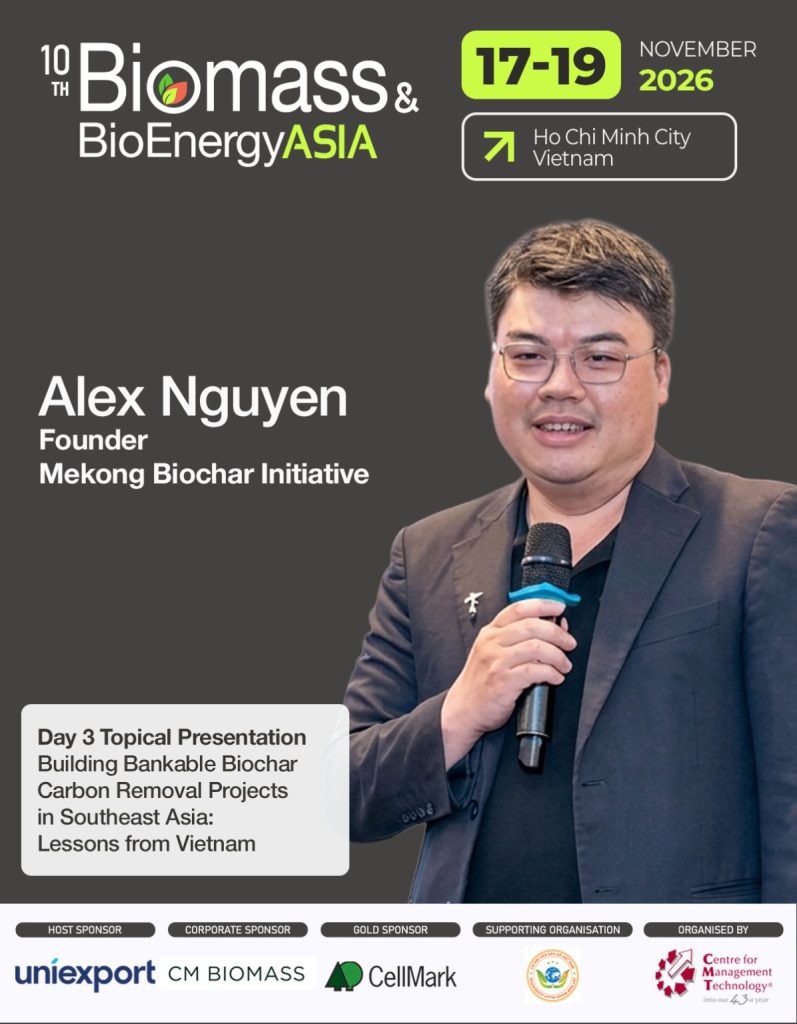
At the 10th Biomass & BioEnergy Asia Conference, taking place in Ho Chi Minh City from 17–19 November 2026, Alex Nguyen, Founder of Mekong Biochar Initiative (MBI), will address this challenge in a presentation titled “Building Bankable Biochar Carbon Removal Projects in Southeast Asia: Lessons from Vietnam.”
Rather than approaching biochar solely as a carbon-credit opportunity, Alex’s presentation will examine how the entire project ecosystem needs to work together — from biomass feedstock and pyrolysis technology to project economics, MRV, carbon markets, investment and end-use applications for biochar.
This is particularly relevant for Southeast Asia, where large volumes of agricultural and forestry residues are generated every year, while many rural economies continue to face challenges in creating higher-value uses for these resources.
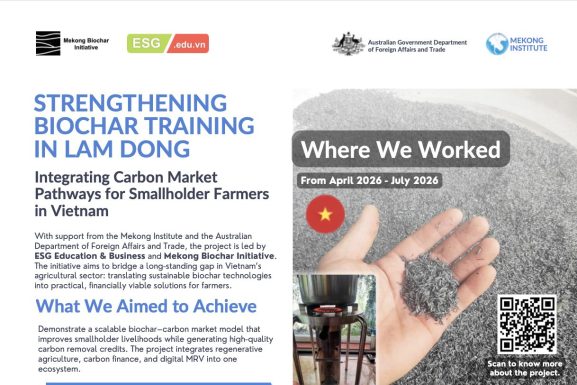
Vietnam provides an important real-world case. Rice husks, wood residues and other forms of biomass are increasingly being considered not simply as waste, but as potential feedstocks for producing biochar, biocarbon and carbon removal products.
The central issue, however, is commercialization.
A technically successful pyrolysis plant does not automatically become a successful carbon removal project. Feedstock availability, logistics, moisture, technology performance, biochar quality, carbon accounting, MRV, certification costs, carbon-credit revenue, biochar offtake and financing structures all have to work together.
Alex’s approach is therefore focused on building projects that can stand on their own commercial fundamentals, with carbon credits providing an additional source of value rather than being the only reason for the project to exist.
The presentation will draw on MBI’s experience developing and implementing biochar projects in Vietnam, including projects using different biomass feedstocks and pyrolysis configurations. It will explore what is required to move from individual pilot projects toward repeatable, scalable and investment-ready project models.
One of the key questions will be how Southeast Asia can move beyond fragmented biochar initiatives and develop a regional ecosystem connecting farmers and biomass suppliers, technology developers, project developers, investors, carbon markets and industrial users.
The discussion also comes at a time when the role of biochar is expanding beyond agriculture. While biochar can contribute to soil improvement and agricultural applications, biocarbon is increasingly being considered as a potential substitute for fossil carbon in hard-to-abate sectors, including metals, chemicals and other industrial applications.
This creates several potential value pools for the sector — carbon removal, agricultural applications, industrial biocarbon, energy and circular-economy solutions — and raises an important question for investors: where will the strongest commercial value ultimately emerge?
For Alex Nguyen, the answer is unlikely to come from carbon credits alone.
The opportunity lies in building integrated business models in which waste becomes feedstock, feedstock becomes biochar, biochar becomes both a carbon-removal asset and a commercial product, and carbon finance helps make the entire system investable.
Vietnam, with its large agricultural sector, significant biomass resources and rapidly developing carbon market, could provide an important testing ground for these models — and potentially a foundation for scaling biochar and carbon removal solutions across the Mekong region and Southeast Asia.
At Biomass & BioEnergy Asia 2026, Alex’s presentation will therefore focus on a practical question facing the industry:
How can Southeast Asia turn its enormous biomass resources into bankable, scalable and commercially viable carbon removal projects?
The lessons from Vietnam may provide part of the answer.