BIOCHAR AND GREENHOUSE GAS MITIGATION IN AGRICULTURE
From emission source to carbon sink in the transition toward climate-smart farming
Agriculture today sits at the center of the climate challenge. It is both highly vulnerable to climate change and a significant contributor to greenhouse gas (GHG) emissions. Globally, the sector accounts for a substantial share of emissions, particularly in the form of methane (CH₄) and nitrous oxide (N₂O)—two gases with far greater global warming potential than carbon dioxide (CO₂). As pressure mounts to decarbonize food systems while maintaining productivity, the need for solutions that can simultaneously reduce emissions and enhance resilience has become increasingly urgent. In this context, biochar is emerging as one of the most promising and scalable interventions.
Unlike many mitigation strategies that focus solely on reducing emissions, biochar offers a dual advantage: it can both avoid emissions and remove carbon from the atmosphere. This unique combination positions biochar as a critical tool in the transition from conventional agriculture to climate-smart and regenerative systems.
Biochar is produced through the thermochemical conversion of biomass under oxygen-limited conditions. During this process, a significant portion of the carbon contained in the biomass is transformed into a stable, aromatic form that resists decomposition. Instead of being released into the atmosphere as CO₂ through natural decay or open burning, this carbon is effectively “locked” into the biochar structure and can remain stable in soils for hundreds to thousands of years. In this sense, biochar functions as a long-term carbon storage medium, turning agricultural systems into carbon sinks rather than emission sources.
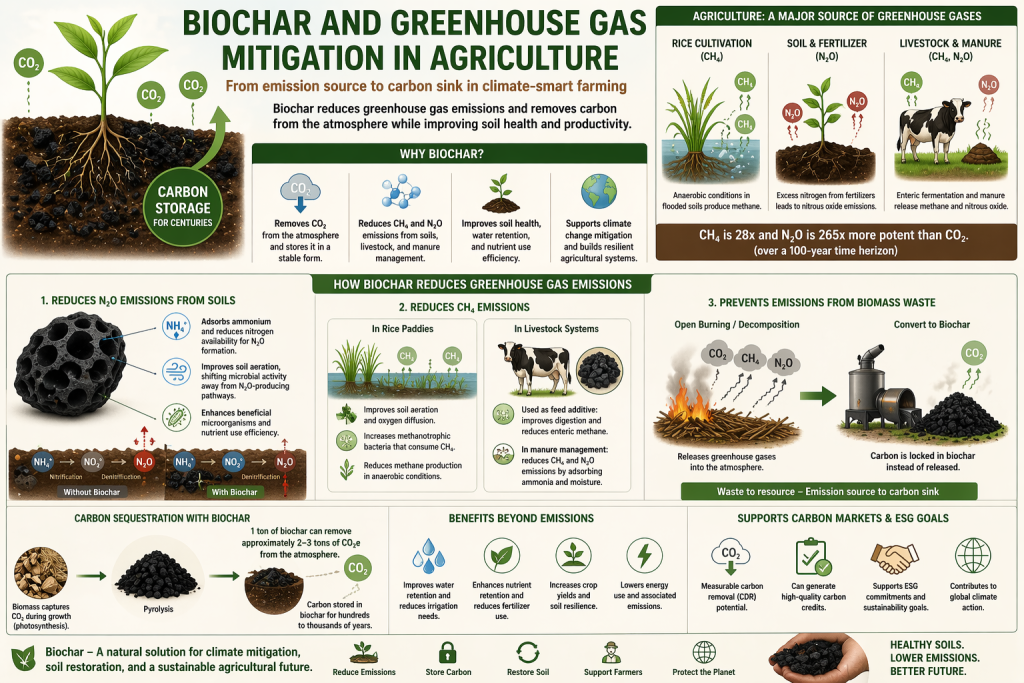
One of the most direct climate benefits of biochar lies in its ability to reduce nitrous oxide emissions from soils. N₂O is primarily generated through microbial processes such as nitrification and denitrification, particularly in soils with excess nitrogen from fertilizers. Biochar influences these processes in several ways. Its high surface area and cation exchange capacity allow it to adsorb ammonium (NH₄⁺), reducing nitrogen losses and limiting the substrate available for N₂O production. At the same time, biochar can improve soil aeration, which shifts microbial activity away from anaerobic pathways that generate nitrous oxide. The result is a measurable reduction in N₂O emissions, often reported in the range of 10% to 50% depending on soil type, application rate, and environmental conditions.
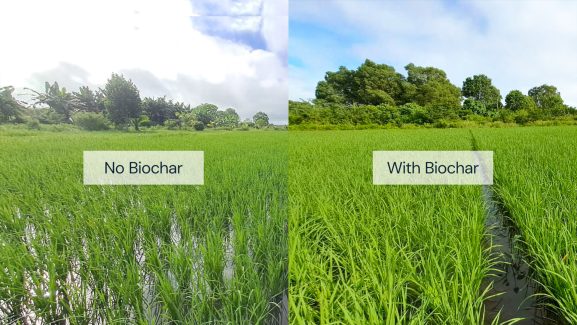
Methane emissions, particularly from rice paddies and livestock systems, represent another major target for mitigation. In flooded rice fields, anaerobic conditions promote the activity of methanogenic microorganisms that produce CH₄. When biochar is applied to such systems, it can alter the microbial community structure and enhance the activity of methanotrophic bacteria—organisms that consume methane before it is released into the atmosphere. Additionally, biochar improves soil structure and oxygen diffusion, further suppressing methane generation. Studies have shown that biochar amendments can reduce methane emissions from rice cultivation by 10% to 30%, while also maintaining or improving yields.
In livestock production, biochar can play a role in reducing emissions both directly and indirectly. When added as a small percentage of feed, biochar has been observed to reduce enteric methane emissions—those produced during digestion in ruminant animals. While the exact mechanisms are still being studied, it is believed that biochar influences the microbial ecosystem in the gut, leading to more efficient digestion and lower methane production. Furthermore, when applied to manure management systems, biochar can adsorb ammonia (NH₃) and reduce the volatilization of nitrogen compounds that contribute to indirect N₂O emissions.
Another important pathway through which biochar contributes to climate mitigation is by preventing emissions from biomass waste. In many agricultural systems, crop residues are either burned in the open or left to decompose, both of which release significant amounts of CO₂, CH₄, and N₂O. By converting these residues into biochar, emissions are not only avoided but transformed into a stable carbon product with long-term value. This approach aligns with circular economy principles, turning waste into a resource while reducing environmental impact.
Beyond these direct effects, biochar also enhances the efficiency of agricultural inputs, leading to indirect emission reductions. By improving nutrient retention, biochar reduces the need for synthetic fertilizers, whose production and application are major sources of greenhouse gases. Similarly, by increasing water retention, biochar can lower irrigation demand and the associated energy use. These systemic benefits make biochar a multiplier effect solution—one that amplifies the sustainability of the entire agricultural system.
From a carbon accounting perspective, biochar is particularly attractive because it fits within the category of carbon dioxide removal (CDR) technologies. Unlike emission reduction strategies that simply slow the rate of climate change, CDR solutions actively remove CO₂ from the atmosphere. Biochar achieves this by capturing carbon during biomass growth (through photosynthesis) and then stabilizing it in a form that resists re-release. Depending on the feedstock and production process, one ton of biochar can represent the removal of approximately 2 to 3 tons of CO₂ equivalent from the atmosphere.
This characteristic has led to growing interest in biochar within carbon markets. Several certification bodies and platforms are developing methodologies to quantify, verify, and trade biochar-based carbon credits. These credits are particularly valuable because they represent durable carbon storage, addressing concerns about permanence that often arise with other nature-based solutions. For farmers and project developers, this creates a new revenue stream that can support the adoption of sustainable practices.
In the context of ESG (Environmental, Social, and Governance) strategies, biochar offers a compelling value proposition. Environmentally, it delivers measurable reductions in greenhouse gas emissions while enhancing soil health and biodiversity. Socially, it supports rural livelihoods by improving productivity and creating opportunities for decentralized biochar production. From a governance perspective, biochar systems can be integrated into monitoring, reporting, and verification (MRV) frameworks, ensuring transparency and accountability.
Despite its potential, the widespread adoption of biochar for climate mitigation faces several challenges. These include the need for standardized production methods, clear guidelines for application, and robust systems for measuring climate impact. There is also a need for investment in technology and infrastructure, particularly in developing countries where the benefits could be most significant. However, as awareness grows and carbon markets mature, these barriers are gradually being addressed.
Looking forward, biochar has the potential to become a cornerstone of climate-smart agriculture. Its ability to bridge multiple objectives—emission reduction, carbon removal, soil restoration, and productivity enhancement—makes it uniquely suited to the complex challenges facing modern food systems. Rather than treating climate mitigation and agricultural development as separate goals, biochar demonstrates that they can be pursued simultaneously through integrated solutions.
In conclusion, biochar represents a shift from linear, extractive agricultural practices toward a more circular and regenerative model. By converting biomass into a stable form of carbon and returning it to the soil, it closes the loop between production and sustainability. More importantly, it redefines the role of agriculture—not just as a source of emissions, but as a powerful agent of climate solutions.