BIOCHAR IN LIVESTOCK PRODUCTION – A NEW GENERATION BIOLOGICAL FEED ADDITIVE
Unlocking animal health, productivity, and low-emission farming systems
In modern livestock production, the search for sustainable alternatives to antibiotics, growth promoters, and chemical additives has become increasingly urgent. Rising concerns over antimicrobial resistance, environmental pollution, and production inefficiencies are pushing the industry toward more natural, resilient, and biologically driven solutions. Within this transition, biochar is emerging as a promising next-generation feed additive—not merely as a supplement, but as a functional material capable of transforming animal health, digestion, and environmental performance.
Traditionally, biochar has been associated with soil improvement and carbon sequestration. However, recent research and field applications have revealed its significant potential in animal nutrition and farm ecosystem management. When used appropriately, biochar operates at the interface between microbiology, digestion, and environmental control, making it a uniquely multifunctional input in livestock systems.
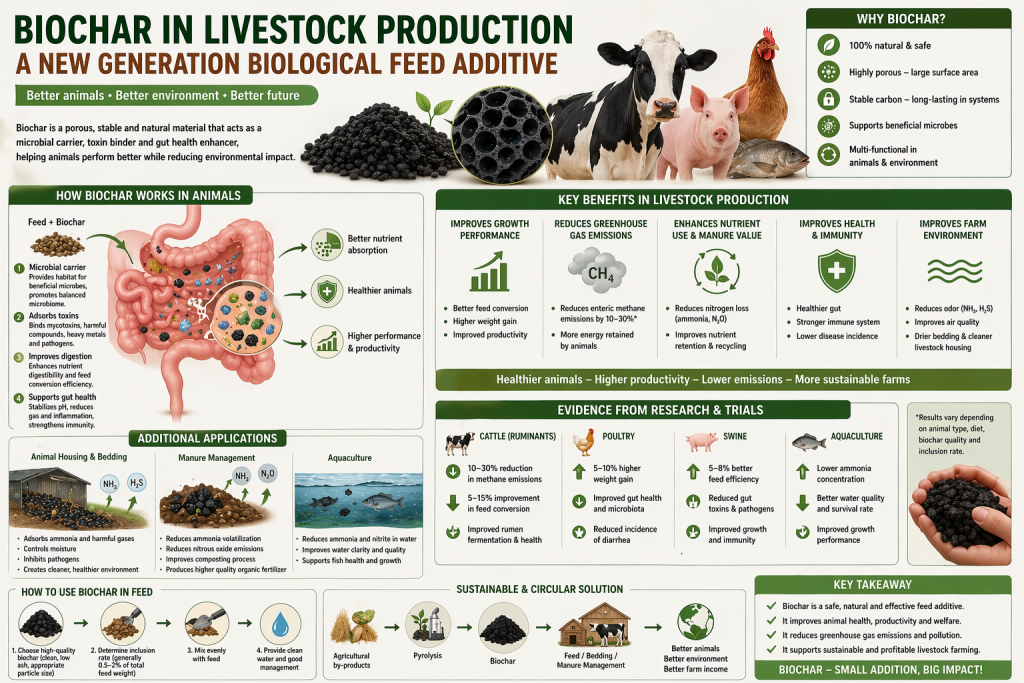
One of the most important roles of biochar in animal production lies in its function as a microbial carrier and prebiotic-like substance. Due to its highly porous structure and large surface area, biochar provides an ideal habitat for beneficial microorganisms. In the digestive system, particularly in ruminants and monogastric animals, this creates a stable environment for microbial communities to thrive. These microbes play a central role in breaking down feed, synthesizing nutrients, and improving overall digestion efficiency.
Unlike conventional feed additives that directly supply nutrients, biochar enhances the biological processes that govern nutrient utilization. It promotes the formation of biofilms—structured microbial communities that increase metabolic efficiency and resilience. As a result, animals are better able to extract nutrients from feed, leading to improved feed conversion ratios and reduced waste.
Another critical benefit of biochar is its strong adsorption capacity, which allows it to bind and neutralize a wide range of toxins present in feed and the digestive system. These include mycotoxins, pesticide residues, heavy metals, and harmful microbial byproducts. By reducing the toxic load, biochar helps protect the gut lining, supports immune function, and minimizes health risks associated with contaminated feed. This is particularly important in tropical agricultural systems, where feed contamination can be a persistent challenge.
In addition to detoxification, biochar contributes to gut health stabilization. It can regulate pH conditions within the digestive tract and reduce excessive fermentation or gas production. In ruminants, this leads to more efficient rumen function, while in poultry and swine, it supports a more balanced intestinal microbiome. The overall effect is improved digestion, reduced incidence of diarrhea or metabolic disorders, and enhanced animal well-being.
One of the most compelling aspects of biochar use in livestock is its impact on greenhouse gas emissions, particularly methane. Enteric methane, produced during digestion in ruminants, represents a significant loss of energy as well as a major environmental concern. Studies have shown that incorporating small amounts of biochar into feed can reduce methane emissions by 10% to 30%, depending on diet composition and animal type. This reduction is believed to result from shifts in microbial pathways toward more efficient fermentation processes.
At the same time, biochar improves nutrient retention, especially nitrogen. By adsorbing ammonia and other nitrogen compounds, it reduces nitrogen losses in manure and enhances the recycling of nutrients within the farm system. This not only lowers environmental pollution—such as ammonia volatilization and nitrate leaching—but also increases the fertilizer value of manure when applied to soils.
The benefits of biochar are not limited to the digestive system. When used in animal housing and manure management, biochar can significantly improve environmental conditions. It acts as a natural deodorizer by adsorbing gases such as ammonia (NH₃) and hydrogen sulfide (H₂S), reducing odor and improving air quality for both animals and workers. In bedding materials, biochar helps control moisture, inhibits pathogen growth, and creates a cleaner, healthier environment.
Real-world applications across different livestock species provide strong evidence of biochar’s effectiveness. In cattle, small additions of biochar to feed have been associated with increased weight gain, improved feed efficiency, and reduced methane emissions. In poultry, biochar supplementation has been linked to faster growth rates, better gut health, and improved resistance to disease. In aquaculture, biochar has been used not only as a feed additive but also as a water treatment agent, helping to reduce ammonia and improve water quality, thereby supporting fish health and growth.
From an economic perspective, biochar offers multiple advantages. It can reduce reliance on expensive feed additives, veterinary treatments, and chemical inputs. At the same time, improvements in animal growth and health translate into higher productivity and profitability. When integrated into circular farming systems, biochar can be produced from farm residues, creating a closed-loop system that reduces waste and generates additional value.
In the context of ESG (Environmental, Social, and Governance) and sustainable agriculture, biochar aligns strongly with key priorities. Environmentally, it reduces emissions, improves waste management, and enhances resource efficiency. Socially, it supports safer food production by reducing the need for antibiotics and chemical additives. From a governance perspective, its impacts can be measured and integrated into sustainability reporting and carbon accounting frameworks.
Despite its potential, the adoption of biochar in livestock systems requires careful consideration. Factors such as dosage, feed composition, biochar quality, and animal species all influence outcomes. High-quality biochar—free from contaminants and produced under controlled conditions—is essential to ensure safety and effectiveness. Moreover, further research and standardization are needed to optimize its use and build confidence among farmers and industry stakeholders.
Looking ahead, biochar represents more than just a feed additive; it is part of a broader shift toward biologically integrated farming systems. By enhancing the natural processes that underpin animal health and productivity, it reduces dependence on synthetic inputs and supports more resilient agricultural models. When combined with other innovations—such as fermented feed, probiotics, and circular waste management—biochar can help redefine livestock production for a low-carbon, sustainable future.
In conclusion, biochar offers a compelling pathway toward transforming livestock systems. Its ability to improve digestion, enhance animal health, reduce emissions, and support environmental management makes it a truly multifunctional solution. As the agriculture sector continues to evolve under the pressures of climate change and sustainability demands, biochar stands out as a practical, scalable, and forward-looking innovation—one that bridges the gap between productivity and responsibility.