BIOCHAR FOR WATER RETENTION – A CLIMATE ADAPTATION SOLUTION FOR AGRICULTURE
As climate change intensifies, water has become one of the most critical constraints in agriculture. Across many regions of the world, including Southeast Asia, farmers are increasingly facing prolonged droughts, erratic rainfall patterns, and declining groundwater levels. In this new reality, the ability of soil to retain water is no longer just a technical parameter—it is a decisive factor for crop survival, productivity, and long-term resilience. Against this backdrop, biochar is emerging as a powerful and practical solution, offering a nature-based approach to enhancing soil water retention while simultaneously supporting climate adaptation.
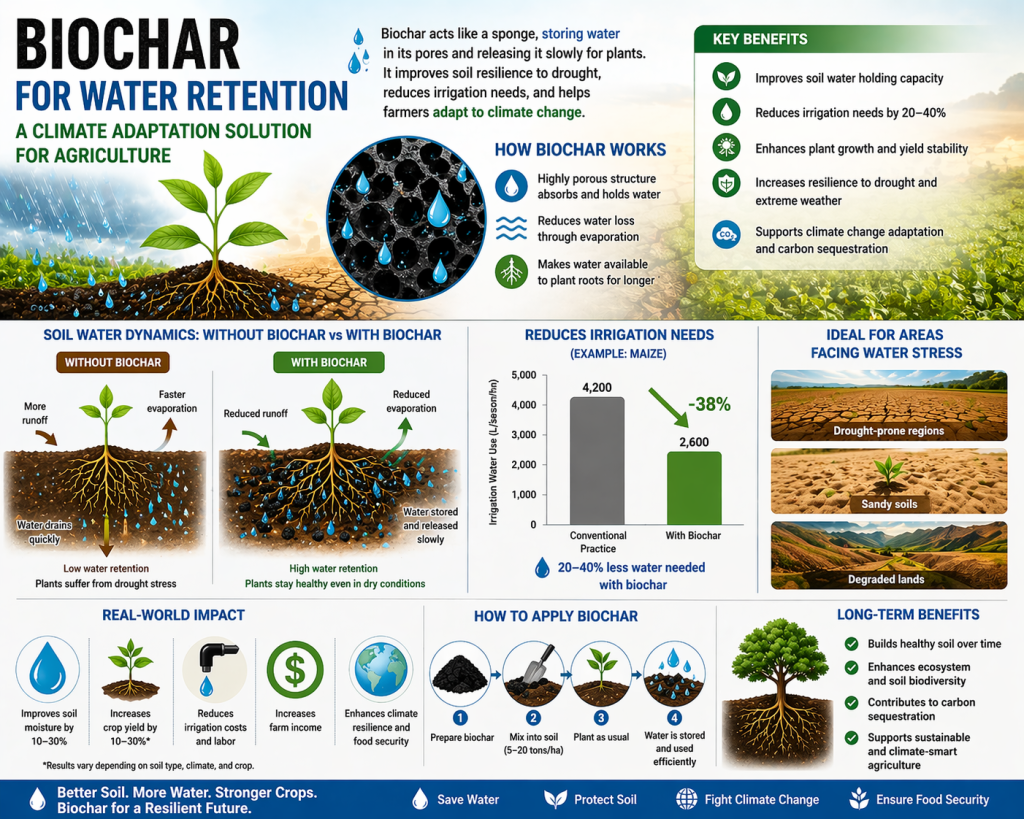
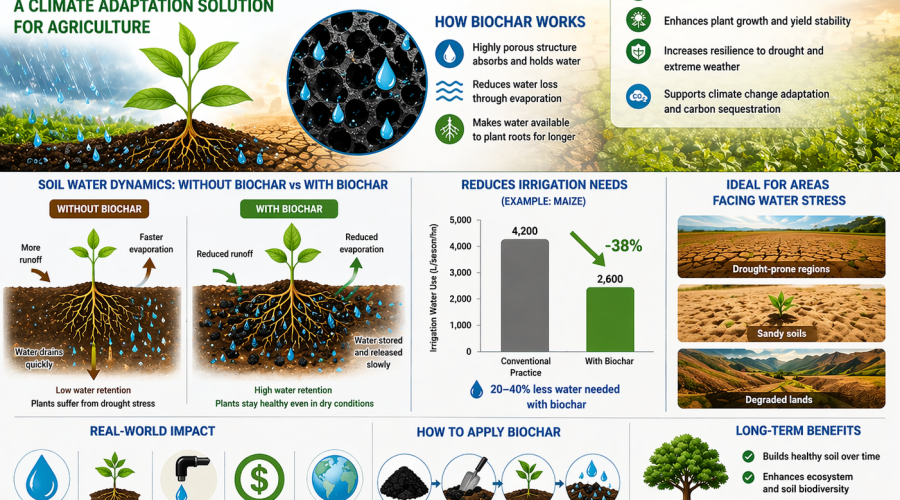
At its core, the effectiveness of biochar in water management lies in its physical structure. Produced through the thermal conversion of biomass under low-oxygen conditions, biochar forms a highly porous material with an extensive internal surface area. These pores, ranging from micro- to nano-scale, act like a network of tiny reservoirs capable of absorbing and holding water. Unlike conventional soil particles, which may compact or degrade over time, biochar maintains its structure, providing a stable and long-lasting medium for water storage.
This “sponge-like” behavior allows biochar to capture water during rainfall or irrigation and gradually release it back into the soil as conditions become drier. The result is a more consistent moisture profile, which benefits both plant roots and soil microorganisms. In environments where water availability fluctuates significantly, this buffering capacity can make the difference between crop failure and successful harvest.
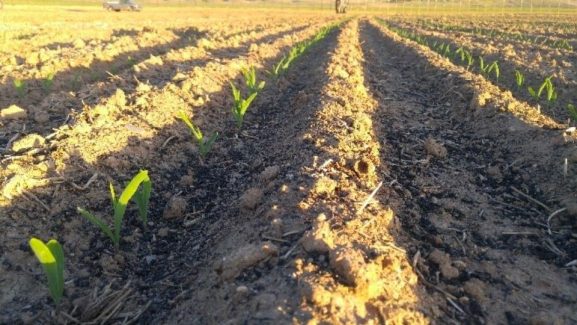
One of the key mechanisms through which biochar enhances water retention is by improving soil porosity and aggregation. When incorporated into soil, biochar reduces bulk density and creates additional pore spaces, allowing water to infiltrate more effectively rather than running off the surface. At the same time, it increases the soil’s capacity to hold water against gravitational loss, particularly in sandy or degraded soils where water typically drains rapidly. This dual function—enhancing both infiltration and retention—makes biochar uniquely effective compared to many traditional soil amendments.
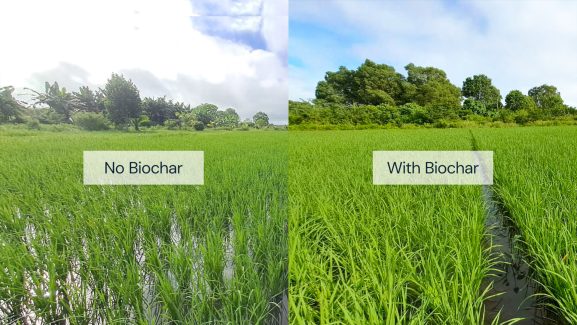
The benefits of this improved water management extend directly to plant performance. With more water available in the root zone over longer periods, plants experience less stress during dry conditions. This leads to more stable growth, improved nutrient uptake, and higher resilience to environmental shocks. In many field studies, the application of biochar has been associated with significant reductions in irrigation requirements—often in the range of 20% to 40%—while maintaining or even increasing crop yields. For farmers, this translates into lower water costs, reduced labor, and greater security in uncertain climates.
Importantly, the impact of biochar is not uniform across all soil types, but tends to be most pronounced in soils with low natural water-holding capacity. Sandy soils, for example, benefit greatly from the addition of biochar, as it compensates for their inherent lack of structure and moisture retention. In contrast, clay soils may experience improvements in aeration and drainage, which indirectly enhance water availability by preventing waterlogging and root damage. In loamy soils, biochar helps to optimize the balance between water retention and drainage, creating more favorable conditions for plant growth.
Beyond its direct effects on soil and crops, biochar also contributes to broader climate adaptation strategies. By reducing the need for frequent irrigation, it lowers energy consumption associated with water pumping and distribution. In regions where irrigation relies on fossil fuels or electricity, this can lead to a meaningful reduction in greenhouse gas emissions. Moreover, by stabilizing crop yields under variable weather conditions, biochar helps to strengthen food security—a critical concern in the face of climate uncertainty.
Another important dimension of biochar’s role in water management is its interaction with soil biology. As discussed in previous analyses, biochar serves as a habitat for microorganisms, which play a key role in soil structure formation. Through the production of extracellular polymers and other binding agents, these microbes help to create stable soil aggregates that further enhance water retention. In this way, biochar does not act alone; it works in synergy with biological processes to build a more resilient soil system.
Real-world applications provide compelling evidence of biochar’s effectiveness. In drought-prone regions, farmers who have incorporated biochar into their soils report not only improved moisture retention but also greater crop stability during dry seasons. For example, in coffee-growing areas of the Central Highlands, biochar has been used to reduce irrigation frequency while maintaining productivity. Similarly, in arid and semi-arid regions, biochar has helped transform marginal lands into viable agricultural systems by improving both water and nutrient dynamics.
From an economic perspective, the value of biochar in water management is multifaceted. While there is an initial cost associated with its production or purchase, this investment is often offset by long-term savings in water, fertilizers, and other inputs. Additionally, the durability of biochar means that its benefits persist over many growing seasons, unlike organic amendments that decompose relatively quickly. This long-term impact makes biochar particularly attractive for smallholder farmers seeking cost-effective and sustainable solutions.
In the context of ESG (Environmental, Social, and Governance) frameworks, biochar aligns strongly with all three pillars. Environmentally, it enhances soil health, conserves water, and contributes to carbon sequestration. Socially, it supports farmer livelihoods by increasing resilience and reducing input costs. From a governance perspective, biochar-based interventions can be measured, reported, and verified, making them suitable for inclusion in sustainability reporting and climate finance mechanisms.
Looking ahead, the integration of biochar into agricultural systems represents a shift toward more adaptive and resource-efficient practices. Rather than relying solely on external inputs to manage water stress, biochar enables farmers to improve the intrinsic capacity of their soils to retain and utilize water effectively. This approach is particularly relevant in the context of climate-smart agriculture, where the goal is to enhance productivity while reducing vulnerability to climate change.
However, realizing the full potential of biochar requires more than just awareness. It calls for the development of appropriate production technologies, tailored application guidelines, and supportive policies that encourage adoption at scale. Research and extension services also play a crucial role in helping farmers understand how to integrate biochar into their existing practices in a way that maximizes benefits.
In conclusion, biochar offers a compelling solution to one of the most pressing challenges in modern agriculture: water scarcity. By transforming soils into more efficient water reservoirs, it enables crops to thrive under increasingly unpredictable climatic conditions. More importantly, it represents a shift in mindset—from managing symptoms to addressing root causes, from short-term fixes to long-term resilience. As climate change continues to reshape the agricultural landscape, solutions like biochar will be essential in building a more sustainable and secure future for food production.