BIOCHAR – THE “MICROBIAL INFRASTRUCTURE” OF AGRICULTURAL SOILS
Over the past several decades, modern agriculture has achieved remarkable gains in productivity through mechanization, improved crop varieties, and the widespread use of chemical fertilizers. However, these advancements have come with a growing and often overlooked cost: the degradation of soil health. Across many regions—particularly in developing countries such as Vietnam—agricultural soils are steadily losing their organic matter, structural integrity, and microbial diversity. These are not minor attributes; they are the very foundation of soil fertility and long-term productivity. As a result, there is an urgent need to rethink how soil is managed—not merely as a medium for plant growth, but as a living ecosystem that must be restored and sustained.
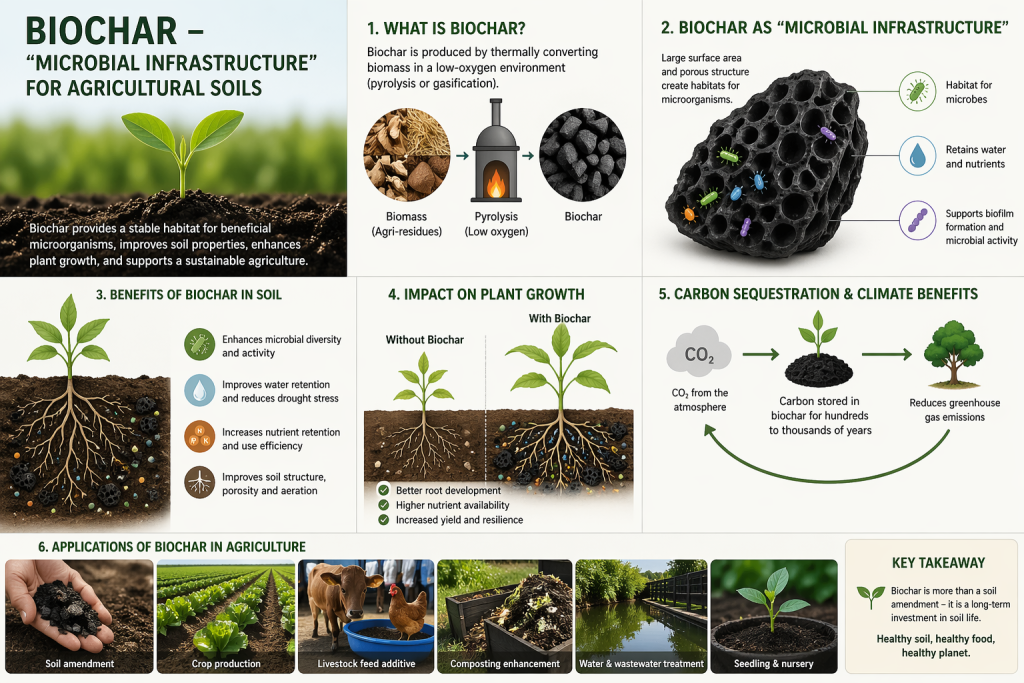
In this context, biochar is emerging as a transformative solution. While it is commonly described as a soil amendment, this definition understates its true potential. Biochar functions more accurately as a form of “microbial infrastructure”—a stable, long-lasting physical framework that supports and enhances the biological life within soils. This shift in perspective is critical. Instead of focusing solely on chemical inputs, biochar invites us to rebuild the biological systems that naturally regulate nutrient cycling, water retention, and plant health.
Biochar is produced through the thermal conversion of biomass—such as rice husks, coffee shells, wood chips, or other agricultural residues—under limited or no oxygen conditions, typically via pyrolysis or gasification. The result is a carbon-rich material with a highly porous structure. What makes biochar unique is not just its carbon content, but its intricate microarchitecture. With a specific surface area that can reach hundreds of square meters per gram, biochar contains an extensive network of micro- and nano-scale pores. These pores create an enormous internal habitat capable of hosting diverse microbial communities.
To understand the significance of this structure, it is essential to revisit the role of microorganisms in soil systems. A single gram of healthy soil can contain billions of microorganisms, including bacteria, fungi, actinomycetes, and protozoa. These organisms are responsible for essential ecological functions: decomposing organic matter into plant-available nutrients, fixing atmospheric nitrogen, solubilizing phosphorus, forming soil aggregates, and protecting plants against pathogens. Despite their importance, these microbial communities are highly sensitive to external disturbances. Intensive farming practices, excessive use of agrochemicals, and climate-related stressors have significantly reduced microbial abundance and diversity in many agricultural soils, effectively rendering them biologically “inactive.”
Biochar directly addresses this challenge by providing a physical refuge and growth platform for microorganisms. Its porous structure acts as a protective habitat, shielding microbes from environmental stress such as extreme temperatures, drought, and pH fluctuations. Within these microhabitats, microorganisms can establish stable colonies and form biofilms—structured communities that enhance nutrient exchange, resilience, and metabolic efficiency. In this sense, biochar does not merely add nutrients to the soil; it creates the conditions necessary for biological processes to thrive.
Another critical function of biochar is its ability to retain water and nutrients. Acting like a sponge, biochar absorbs and holds moisture within its pore structure, making it available to both plants and microorganisms over extended periods. This is particularly valuable in sandy or degraded soils, where water typically drains rapidly and nutrients are easily lost. By improving water retention, biochar not only enhances plant resilience during dry periods but also stabilizes the microbial environment, enabling continuous biological activity.
Unlike organic matter that decomposes relatively quickly, biochar is highly stable and can persist in soils for hundreds to thousands of years. This durability makes it an ideal long-term investment in soil health. It provides a consistent structural framework that supports microbial ecosystems over time, allowing soils to gradually recover their biological complexity. In this way, biochar contributes to a transition from short-term, input-driven agriculture toward a more regenerative model that emphasizes resilience and sustainability.
The impact of biochar extends beyond biological functions to include significant improvements in soil physical properties. By increasing porosity and reducing bulk density, biochar enhances soil aeration and root penetration. It also improves aggregation, which helps prevent erosion and compaction. These changes create a more favorable environment for both plant roots and soil organisms, leading to better overall crop performance. In water-limited environments, the ability of biochar to increase soil water-holding capacity can be particularly transformative, reducing irrigation requirements and mitigating the effects of climate variability.
Globally, biochar is gaining recognition as a key component of regenerative agriculture—a farming approach that seeks not only to sustain but to restore ecosystems. Regenerative agriculture emphasizes soil health, biodiversity, and carbon sequestration, all of which align closely with the properties of biochar. By integrating biochar into agricultural systems, farmers can simultaneously improve productivity, enhance ecosystem services, and contribute to climate change mitigation.
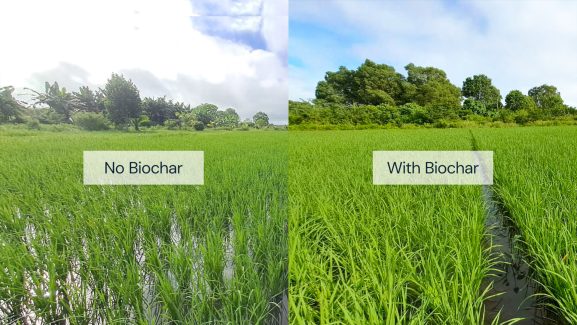
Empirical studies and field applications have demonstrated that biochar can increase crop yields, improve nutrient use efficiency, and enhance plant resistance to stress. However, the most significant benefit lies in its ability to create a stable and self-reinforcing system. Once the microbial ecosystem is reestablished, it continues to support plant growth with reduced dependence on external inputs. This represents a fundamental shift from conventional agriculture, where productivity is often maintained through continuous chemical supplementation.
Vietnam, in particular, is well-positioned to benefit from biochar technologies. The country generates large volumes of agricultural residues—such as rice husks, straw, and coffee by-products—that can be converted into biochar. At the same time, many regions are experiencing soil degradation, water scarcity, and increasing pressure to reduce greenhouse gas emissions. Biochar offers a practical and scalable solution that addresses all of these challenges simultaneously. However, widespread adoption will require greater awareness, appropriate technologies for smallholder farmers, and the development of technical standards and policy support.
From an ESG (Environmental, Social, and Governance) perspective, biochar represents a highly strategic intervention. Environmentally, it improves soil quality, reduces emissions, and sequesters carbon in a stable form. Socially, it can enhance farmer livelihoods by increasing yields and reducing input costs. From a governance standpoint, biochar systems can be measured, monitored, and verified, making them suitable for integration into carbon credit frameworks. In fact, biochar is one of the few solutions capable of generating carbon removal credits, a rapidly growing segment of the global carbon market.
Looking ahead, the true value of biochar lies not only in the material itself but in the systems it enables. It can serve as a central component in circular agricultural models, where waste is converted into energy and soil amendments, nutrients are retained within the system, and environmental impacts are minimized. When combined with other innovations—such as microbial inoculants, organic fertilizers, and integrated farming practices—biochar can help create resilient, low-carbon agricultural ecosystems.
In conclusion, biochar represents a paradigm shift in how we understand and manage soil. Rather than treating soil as an inert substrate, it encourages us to recognize and invest in its biological complexity. As a “microbial infrastructure,” biochar provides the foundation upon which healthy, productive, and sustainable agricultural systems can be built. In an era defined by climate challenges and resource constraints, such solutions are not merely beneficial—they are essential for the future of agriculture.